

Shortly after being hired in 1893 as history professor at the Ohio State University, Wilbur Henry Siebert assigned one of his classes a project to gather information on the Underground Railroad.
The class was to gather names, addresses and/or stories from their relatives and friends who might have had connections to the Underground Railroad. He sent letters to any names and addresses he received which brought responses, more information and more questions. That prompted another round of letters and another round of responses which expanded the study to cover the entire United States.
The timing of what would turn out to be one of the most extensive historical studies of the UGRR in the United States could not be more critical. The UGRR was fading into our nation’s history with foggy documentation of names, places, atrocities, facts and escapes. The Civil War ended thirty years prior and with it the UGRR.
From this almost happenstance school assignment came ‘The Underground Railroad from slavery to freedom’ published in 1898. In this important historical book Siebert was able to tell many stories that otherwise would have been lost to history. Many the stories he was able to uncover and publish had happy endings because most of the runaways – with the help of the north – were able to make it to freedom. Unfortunately, that number is small in comparison to the total number of slaves being held.
For the next sixty years, this became Siebert’s life work.
Professor Siebert was born in Columbus in 1866 and graduated from Ohio State Univ in 1888; he received an M.A. from Harvard in 1890; and studied in Germany in 1890 & 1891.
In August, 1893, he married Annie Ware Sabine who was a painter from Massachusetts. Annie became the first female to earn a Master of Arts degree from Ohio State University, where a women’s dorm was named in her honor. She also became the first woman to earn an architecture degree from MIT two years later.
Wilbur was chairman of the department of European History for twenty three years beginning in 1902. He then became a research professor.
Despite bigger claims from the east, “the Ohio – Kentucky routes probably served more fugitives than others in the north,” according to Siebert. It is believed that as many freedom seekers traveled through the tiny Ohio river town of Ripley as the larger cities of New York and Cincinnati.
At the time prior to the Civil War, Ohio shared almost 400 miles of border with the south – 160 miles of river frontage with Kentucky and at the time 225 miles of border shared with Virginia. West Virginia did not become a state until 1863.
Ohio had what is thought to be by far the most routes for freedom seekers to travel through the state and a large number of stations as well.
The most widely known links in central Ohio were in Mechanicsburg (35 miles west of Columbus), Marysville (33 miles northwest) and Mansfield. (65 miles north). Because these were private residences, a lot of the stations have faded into history though it has been reported that Columbus had at least twenty stations.
His research on the UGRR resulted in maps of Ohio detailing routes freedom seekers took to Canada. The west half of Ohio’s lake shore were to most popular destinations to cross Lake Erie to Canada. They included Toledo, Sandusky, Huron, Vermillion and Lorain.
The farther west on land in Ohio the shorter the boat ride across to freedom. Ft Malden was a popular landing spot in Canada. From Perrysburg, it was about 84 miles by water; from Lorain about 156 miles.
“Words cannot describe the feelings experienced by my companions as they neared the shore; their bosums were swelling with inexpressible joy as they mounted the seats of the boat, ready eagerly to spring forward and touch the soil of a freeman,” says abolitionist, former slave and boat captain Josiah Henson. “And when they reached the shore they danced and wept for joy, and kissed the earth on which they first stepped, no longer the slave but the free.”
Prior to the War of 1812, slaves were kept in the dark about the freedoms that Canada offered.
Among those who Dr Siebert interviewed for his book was Rev James Poindexter who was the first African American elected to Columbus City Council and who was a conductor on the UGRR.
Siebert retired in 1935 and became professor emeritus. He wrote ‘Mysteries of the Underground Railroad in Ohio’ in 1951 at the age of 85.
Wilbur H Siebert died at his home (182 W Tenth Ave) in Columbus on September 2, 1961 – one hundred years (and four months) from when the Civil War broke out. He was 95. He is buried at Sunset Cemetery in Galloway.
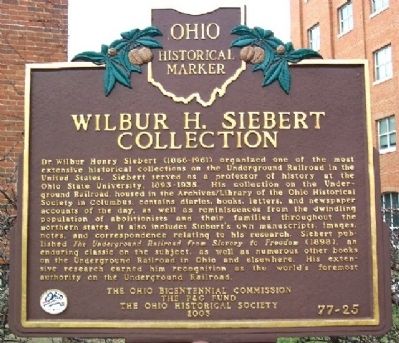
Siebert’s Underground Railroad collection which includes diaries, books, letters, newspaper accounts, manuscripts, notes and correspondence is housed in the Archives section of the Ohio History Connection in Columbus.
Dr Siebert was honored in 1959 – two years before he died – as one of twenty six persons whose name had been in every copy of the ‘Who’s Who in America’ for sixty years.
The Ohio Bicentennial Commission honored Siebert in 2003 with an Ohio Historical Society marker on the Ohio State University campus at Dulles Hall (230 W 17th Ave).
His extensive research earned him recognition as one of the world’s foremost historians on the Underground Railroad.
Sources: Underground Railroad from slavery to freedom by Wilbur H Siebert; Underground Railroad in Ohio by Kathy Schulz; remarkableohio.org; https://ohiomemory.org.org/digital/collection/siebert; Siebert, ‘Widely Known Historian and OSU faculty member is dead,’ Columbus Evening Dispatch, Sep 4, 1961; https://www.ohiohistory.org/; Wikipedia; www.americanart.si.edu; James Preston Poindexter Elder Statesman of Columbus by Richard Clyde Minor, reprinted from the Ohio State Archaeological & Historical Quarterly, July 1947; Featured picture courtesy of Columbus Metropolitan Library; Picture2: https://www.hmdb.org/results.asp?Search=KeywordA&SearchFor=franklin+county+ohio