
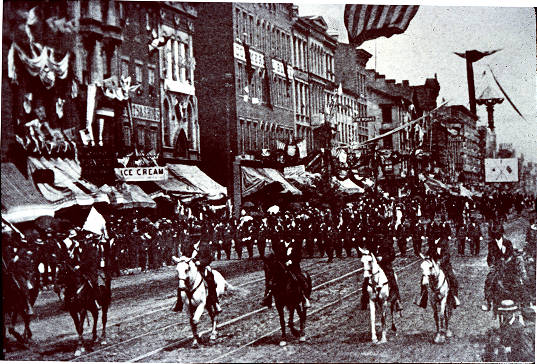
In the fall of 1888, Columbus, Ohio was about to host the last great march of the Union Army. According to Columbus historian Ed Lentz, “it was one of the great moments in the city’s history.”
Life expectancy of a male at that time was 53 years. Twenty five veterans of the great Union Army passed away every day. The Civil War had ended over two decades prior. Do the math.
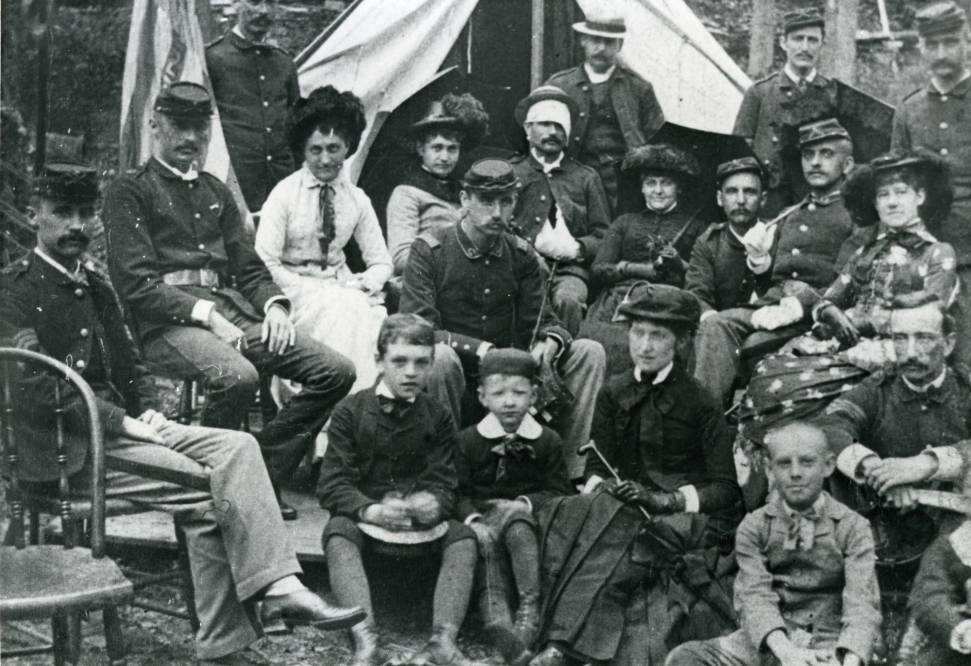
Union Depot bustled with energy as Civil War veterans and their families arrived in Columbus from every corner of the country. It was the week of September 10, 1888. The California delegation endured seven days of travel just to get here.
Incoming trains the first couple of days were non-stop day and night. Columbus had emerged from the war with one of the nation’s healthiest confluences of rail.
Close to 100,000 soldiers and 150,000 wives & family arrived for the weeklong encampment of the Grand Army of the Republic – the veterans’ organization of the Union Army. Ohio was celebrating the centennial of the Northwest Ordinance (1787).
All arriving delegations were met by a welcoming party at the massive brick & stone barn that was the Union Depot. New arrivals were handed a 19-page program with the itinerary & information and escorted to their accommodations.
Columbus was prepared.
Hotel lobbies teemed with excitement and chaos. Former president Rutherford B Hayes, the GAR Commander-in-Chief JB Rea, and Civil War hero General William ‘Tecumseh’ Sherman arrived and were quickly in high demand. Sherman stayed at the home of Mrs Colonel Steele on 106 East Broad St. and was serenaded regularly by veterans. He would die of pneumonia three years later.
Local Columbus women helped decorate homes and buildings around the city in red, white and blue bunting. Wooden and iron arches were erected across High Street every half block with gas light that illuminated the streets. For the GAR event the arches were decorated with flags, bunting and ribbons. Over one arch in front of the capital, a large ‘Ohio’ sign was illuminated at night.
Delegations came uniformed up with banners, colors flying and escorted by a drum corps or a band. The streets of Columbus echoed with the sound of music and columns of marching men clad in blue.
These were all Union veterans who had fought shoulder to shoulder twenty five years earlier in combat. Love and respect was in the air.
Columbus did not have nearly enough hotel space, so thousands of tents were set up in five camps – two near Ft Hayes, one near Goodale Park, one near the Ohio statehouse, and one on the far east side. Local farmers donated sixty wagonloads of straw. Columbus’ population was only 80,000.
This was the Grand Army of the Republic’s biggest reunion since the end of the Civil War. It would be the biggest parade of the U.S. military since the Grand Review in Washington in 1865 and it would be the highlight of this convention.
The skies were bright and the air was comfortable on the day of the grand parade. Viewing stands were erected along the parade route. The main reviewing stand with dignitaries was positioned on Broad between High and Third St. The 2.5 mile parade route was to head down Third St to State, head west then turn up High St. past Broad and loop back around. The finish was just past the main reviewing stand on Broad St.
The parade lasted 4.5 hours, but nobody seemed to notice.
“There has never been such a parade of soldiers as we have seen today since the boys in 1865 came fresh from the field and marched in review up Pennsylvania Ave,” said Corporal James Tanner of New York. “You younger men may call us old, but I tell you that the blood that was hot in 1861 hasn’t cooled off yet.”
Delegations from Ohio outnumbered all the other states combined. Ohio had sent over 400,000 men to fight in the Civil War, one of the largest contingents of any state. Meanwhile, the membership of the Great Army of the Republic peaked in the late 1800s at 395,000.
There were 3800 tents in the encampment spread across Columbus. Wives and children were sent to boarding houses. There were five mammoth dining halls erected with each capable of serving 75,000 people. Each hall was staffed with 150 waiters and had a refrigerator that required a carload of ice per day.
Columbus in 1888 had indoor plumbing, telephone service and the latest fashions for the rich. Little was available for the poor.
There was a large contingent of the Sons of Veterans – some 1500 – who were honored on the first day with a parade. Upon seeing the Sons of Veterans march by, one of the general’s wives turned to Ohio Governor Foraker and said “I have no fears for the future of my country.”
Every night each camp hosted a campfire with speakers and music and singing. The GAR male chorus of 325 voices along with a chorus of 1500 school children were divided up into divisions to accommodate the nightly campfires throughout the city. The chorus teams traveled by wagon from campfire to campfire to sing.
Governor Foraker was treated like a rock star wherever he went as were a couple of the surviving members of Andrews Raiders who were on hand.
“We are quite ready to admit tonight that Ohio is the greatest state in the Union,” said NY Senator Warner Miller. “We have long thought she took all the offices, now she seems to have taken all the soldiers. I thought yesterday as the parade marched by that America need fear nothing from any country on earth. No emergency can possibly arise which cannot be met by the citizens of this free republic.”
Sources: A historical guide to old Columbus by Bob Hunter, 2012; Columbus – the story of a city by Ed Lentz; Grand Army of the Republic by John Edmonds, 2018; Columbus 1860 – 1910 by Richard Barrett; Columbus Evening Dispatch, Sept 10 – 14, 1888; Columbus Monthly, ‘Columbus’ Golden Age of Conventions by Ed Lentz and Austin Kerr, Sep 1980; ‘The Civil War – search for soldiers’, national park service, nps.org; Department of New York Sons of Veterans of the Civil War, James Tanner, nysuvcw.org.