
Owners of the ‘Circus House’ off Goodale Park in Columbus over the years have claimed that the house is haunted. One former owner told the Columbus Dispatch in 2018 that he tried to set up his office in the former bedroom of Mary Sells. “I realized I just couldn’t focus in the bedroom,” he said. “She wanted me out of there.”
He moved his office. “I do things when the house tells me to.”
He didn’t stay long.
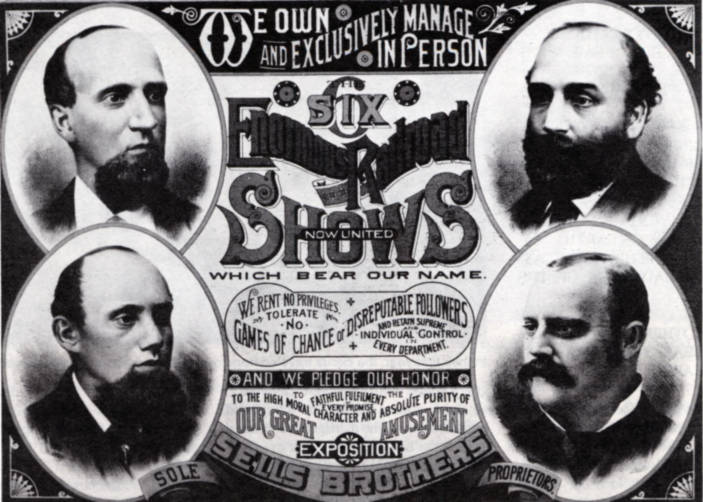
Late in the nineteenth century, the Sells Brothers Circus – with headquarters here in Columbus, Ohio – was the second largest in America.
Four brothers ran the Circus. The youngest brother Peter Sells built a 7400 square foot mansion near Goodale Park in 1895 for his young bride. He was 32. Mary was 18. The house was affectionately called the ‘Circus House’ because it resembles a Victorian Gothic circus tent.
Peter was on the road a lot. The season would open in Columbus in mid-April and the circus would be booked through November. Mary became lonely. She eventually was caught having an affair with wealthy and well-known bachelor William Bott. He owned a local billiard parlor and saloon with his brother. The couple divorced. Mary was scrutinized and decided to leave town.
At its height, the Sells Brothers brought with them on the road: a 328 ft big top, six other large tents, over three hundred workers, sixty four performers, thirteen elephants, seven camels, fifty cages of wild animals that included numerous pumas, black panthers, antelopes, a hyena, a lion, tigers, leopards, bears, zebras, rhinoceroses, sea lions, monkeys, hippos, and two hundred fifty horses.
Annie Oakley and her husband Frank Butler toured with the Sells Brothers Circus for one season in 1880. They left and gained worldwide fame & fortune traveling with Buffalo Bill.
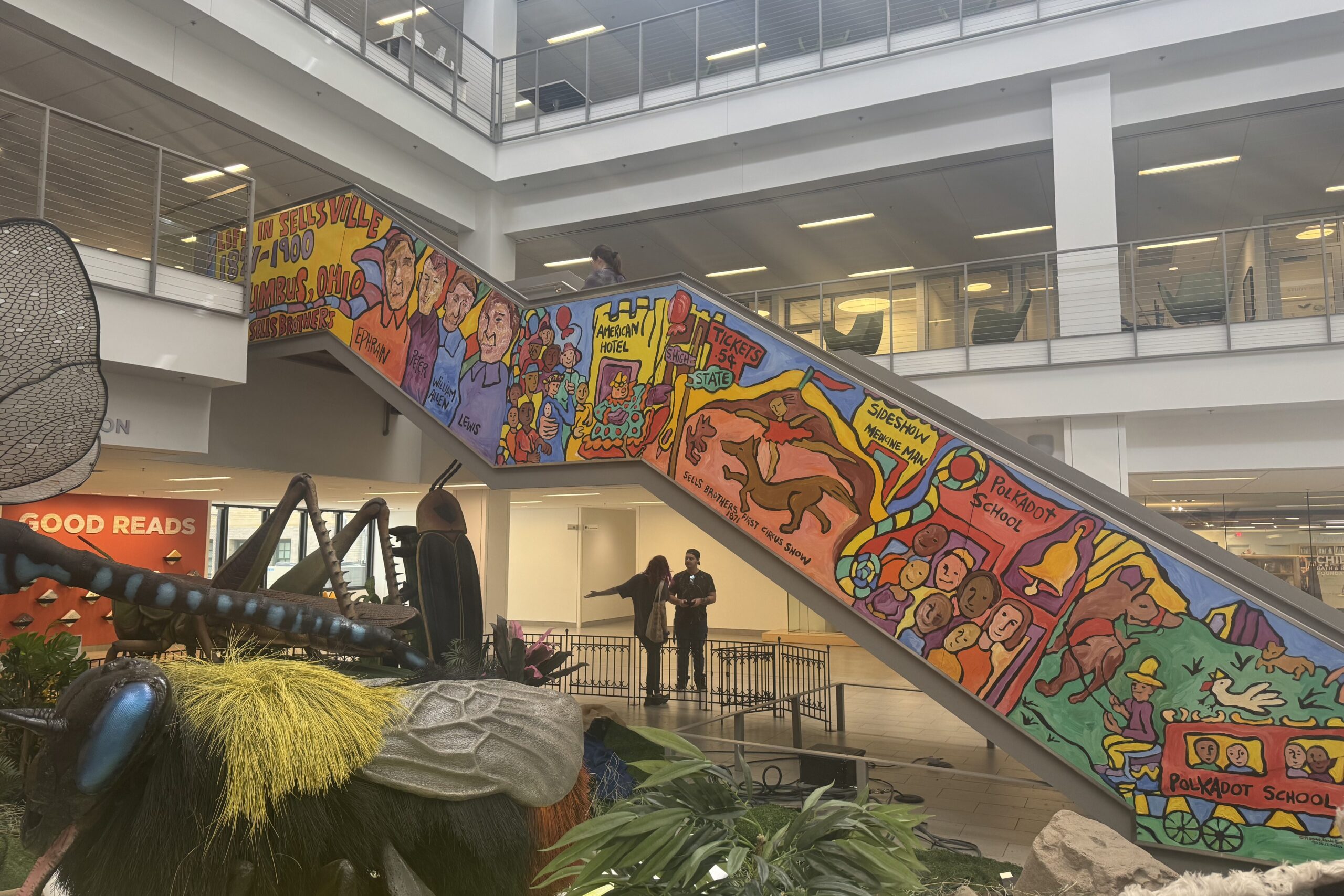
The Sells Brothers headquarters was at 850 W Fifth Ave. The area around it became their winter quarters for all their animals and some employees. It would be dubbed ‘Sellsville’ and would grow to 1000 acres.
Sellsville had grown to encompass the land from the Olentangy River to Virginia Ave and from W Fifth Ave to King Ave. The Sellsville winter community included living quarters and a dining hall for fifty. The circus employees were mostly transplanted former slaves and indigenous people.
The circus grounds had its own agriculture; its own one room schoolhouse in 1900 called the Polkadot School because it was 50% white and 50% black; its own grocery; four slaughter houses; harness, buggy and blacksmith shops; a Saloon; the Antioch Baptist Church; the Salzgeber Coal & Building Supplies and the Weisheimer flour mill.
One evening lifetime resident Howard Griffith was cutting across the Sellsville property when he ran into five polar bears who had escaped from their cage. He said he turned and ran and didn’t stop until he got home. The bears were rounded up. Griffith also remembers crossing the Fifth Ave bridge during the Flood of 1913 and the water was waist high.
Sellsville resident George Finkes was returning home one night and was just starting to cross over on the W Fifth Ave bridge when he spotted an elephant walking toward him on the other end of the bridge. George climbed the bridge’s iron columns. The elephant felt the bridge shake slightly as he neared the center and decided to retreat.
The Appetite Saloon was operated by a former Sells Brothers elephant trainer ‘Star Kid’ Chambers. It had sawdust floors and was open 24 hours a day to service all shifts. The saloon offered a barbershop and games of cards.
There was at least one altercation in the saloon with an iron stove poker after claims of cheating in a card game that resulted in a man being killed. The saloon closed in 1906 after the circus’ winter quarters closed.
While the circus was out on the road in the summer, Sellsville attracted bands of gypsies. They would stay in the woods between King & W. Fifth Ave. They would tell fortunes, play cards and were very good horse & pony traders. The wagons they pulled up in were pulled by some of the finest horses. The gypsies also made violins out of roots of trees which produced excellent sounds.
After three consecutive bad years, however, and the death of one of the four brothers (William Allen) in 1894 the Sells Brothers merged with Adam Forepaugh in 1895. It became Forepaugh-Sells vs Ringling Brothers.
In 1898 after the death of the second and oldest brother Ephraim, James Bailey of Barnum & Bailey and WW Cole of the Cole Brothers Circus each acquired 25% interest in the Sells Bros Circus. The brothers were aging and realized they had no succession plan. None of their children were interested in the circus.
In 1900 there were ninety seven structures in Sellsville including businesses and residences as detailed in Carl Weisheimer’s 1971 book ‘Sellsville’.
In 1902, in one of the Sells Brothers’ last big shows, the circus opened at Madison Square Gardens (the second of four versions of MSG).
Peter Sells died in 1904. The last remaining brother – Lewis – then decided to sell the circus. In 1905 they held an auction. The first and only bid came from JA Bailey of Ringling Brothers & Barnum & Bailey who bid $150,000. That was it. The auction ended.
The winter quarters remained in Columbus until 1907 the same year Lewis Sells died. By 1910 the Columbus headquarters closed.
Columbus Showcase Company occupied the Sells Brothers headquarters until it closed its doors in August 2013.
The ‘Circus House’ still stands today and was one of the headliners in the 2018 Short North Tour of Homes & Gardens.
Sources: Columbus Unforgettables by Fred Pfening jr; Sellsville by Carl Weisheimer 1971; As it Were by Ed Lentz; WOSU public media (YouTube), Columbus Neighborhoods: Sells Brothers Circus, February, 24, 2017; 101 things you didn’t know about Columbus Ohio, By Horace Martin Woodhouse, 2010; On this date in Columbus, OH history 2013, by Tom Betti and Doreen Uhas Sauer, For the Columbus Landmarks Foundation; A Historic Guidebook to old Columbus by Bob Hunter; Columbus Neighborhoods – A guide to Landmarks, by Tom Betti, Ed Lentz and Doreen Uhas Sauer; Columbus 1860 – 1910, by Richard E Barrett; Columbus Dispatch, Big-top legacy by Jim Weiker, Sept 9, 2018; Featured picture courtesy the Columbus Metropolitan Library.