

In June 1950 Communism was on the march. Again. North Korea – with the support of Russia and the Chinese – crossed the 38th parallel. Seoul, South Korea was captured by June 28.
Comparing North Korea expansionism to Hitler helped sway U.S. public opinion to enter the war. Unfortunately, President Truman had cut back support of the military. We were woefully unprepared. The 24th Infantry was one of the first to arrive in Korea and they took heavy casualties.
Former General Dwight D Eisenhower won election as president in November 1952 and visited the U.S. troops in Korea on December 2. He began actively seeking an end to hostilities through a combination of military muscle flexing and diplomacy.
At 20-years-old and fresh out of Holy Family High School, my father – Dick Hetterscheidt – enlisted with the U.S. Army. It was the fall of 1952. He was sent to basic training at Ft Knox for nearly six months and then shipped off to Korea. His ship landed on May 1, 1953.
His letters home for the next twelve months serve as a diary of his experiences:
Friday, May 1, 1953:
“Well I am finally at my outfit in Korea. It sure felt good to hit land once again, even if it is Korean land. There was a train waiting for us. Boy was it ever old. It even had wooden seats in it and boy was it uncomfortable. We were on the train from 10PM last night until 8 this morning. Let me tell you I never was so miserable in all my life as I was last night. Boy it was cold out. And that train smelled like the ones that used it before didn’t make it to the latrine.”
My dad wrote to his high school sweetheart Peggy – my mother. They were deeply in love. She was two years into her nursing degree when he left. While he was deployed, she graduated in the spring of 1953.
Dick’s outfit soon made its way to the frontline, we think somewhere north of Chuncheon. All the fighting in 1953 was along the 160 mile 38th parallel. His regiment rotated in to stand guard on what he called ‘the hill’.
Sunday, May 3, 1953:
“They marched us to a field where the commanding General of the 45th division was to talk to us. He came back from the front lines in a helicopter. He told us all about our outfit. He said it wasn’t as bad as people tell you, so honey please don’t worry about me. So far I am not scared and with prayers and God’s help I won’t get scared. We will probably go up front Mother’s Day.”
The Chinese had entered the war shortly after it began on October 8, 1950. They were very well trained and well disciplined.
By the time my father arrived, the war was essentially the Americans vs the Chinese. It became a war of attrition.
Tuesday, June 23, 1953:
“The 279th relieved us last night about 10PM. We have been expecting it for a long time but I couldn’t tell you. Sure feels good to get off the hill. We came off the hill about 11PM and as soon as we started off it got real cruddy & cold and then it started raining. It sure was a miserable night. We had to come down that big hill with a full field pack. It was really heck. They had trucks waiting on us. They all were open trucks. Boy I got soaked to the skin. We got started in the trucks about 1AM and we got here about 5AM.”
Six months after Eisenhower’s inauguration, armistice negotiations commenced.
On July 27, 1953, an armistice was signed. The major point of contention in the negotiations was not ending the fighting or even where the dividing line was. It was the release of POWs.
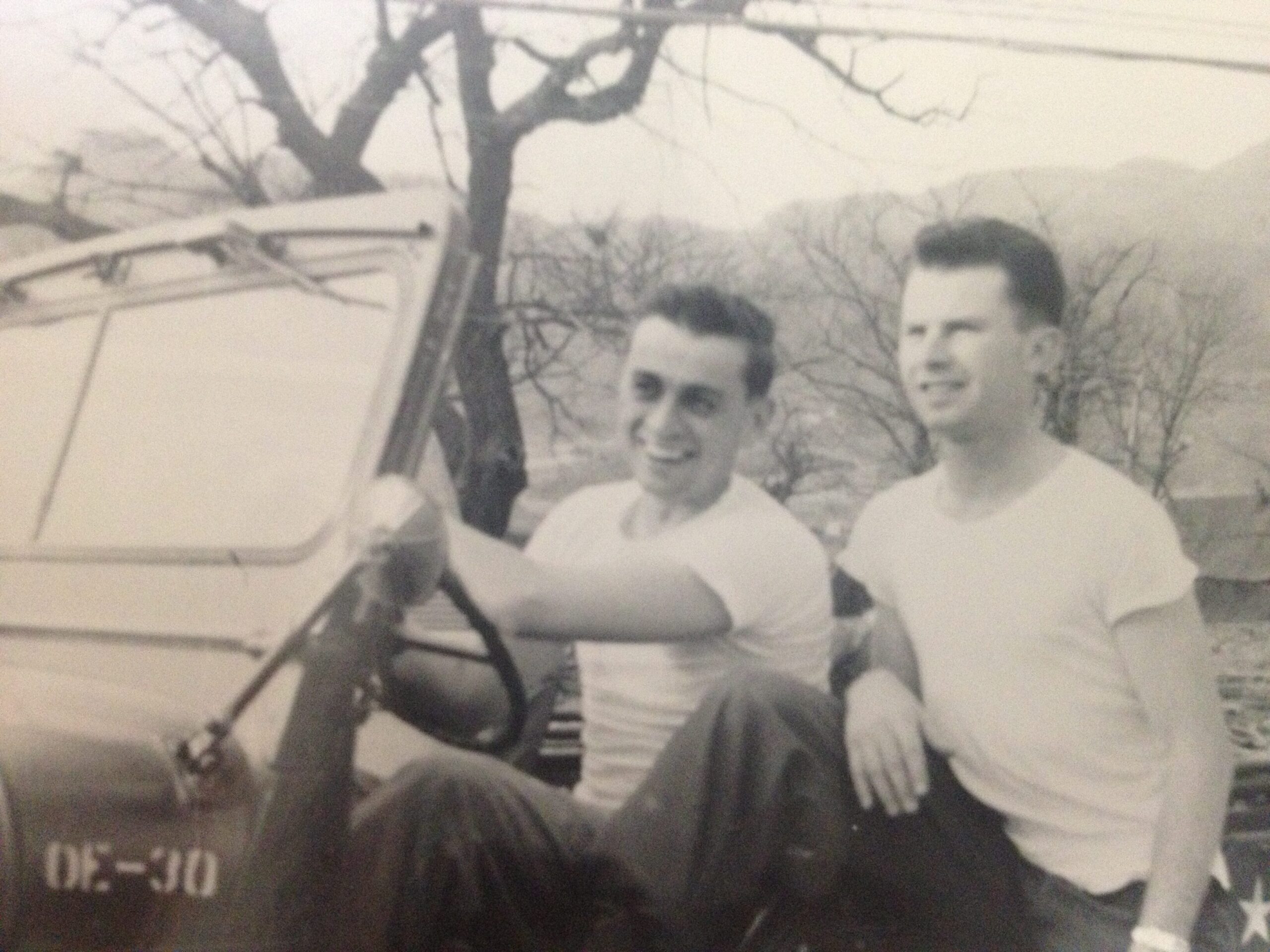
Wednesday, July 29, 1953:
“I think I wrote to you last the morning they signed the truce. Anyway, it really was peaceful all that day with a few rounds here and there. The cease fire was at 10PM. I had first guard about 8PM. (Then) they threw everything at us but the kitchen sink and big ones too. Our Lord sure was watching over us because no one got hurt, except one fellow’s hoochie caved in on him.”
My father was among the first two U.S. divisions sent home from Korea in April 1954. Four of the remaining six divisions were sent home in August 1954.
Wednesday, April 21, 1954:
“Dear Honey
I am on my way !!
Left QM Company 11AM, April 21, 1954. Left Division Rear at 6AM, April 22, 1954. Board ship April 23, 1954. Approximate date to arrive in states May 5, 1954.
So honey plan a wedding.
Get your vacation.
I love you honey.
With always Love
Your Fiancé
Dick
PS – May 15 we can get married.”
Dick and Peggy were married at St Thomas the Apostle Church on May 22, 1954. The church is still there today.
They were married 58 years, had five children, eleven grandchildren and ten great grandchildren.
In the end, the Communists and the Capitalists agreed to a tie in the three year Korean War. America was under prepared. We got to a tie with grit.
A demilitarized zone was established at the 38th parallel – the dividing line between North and South Korea – that has been protected and overseen by an international coalition.
Unfortunately, my father, who was athletic and a picture of health in his 20s, developed severe stomach issues shortly after returning to the United States. It was attributed to spoiled sea rations he consumed on the ship coming home. He had no choice but to have ileostomy surgery to bypass his large intestine and rectum to relieve the pain.
He suffered with its social and emotional challenges the rest of his life. It severely affected his marriage.
Many years later we applied for medical compensation from the Veterans Administration. We were denied.
George R. Hetterscheidt died at his home in Hilliard surrounded by his family on November 23, 2013. He was 81. We lost our mother Peggy the year before, burying her on her 80th birthday.
We never spoke to our father about his twelve months in Korea.
On the 42nd anniversary of the armistice being signed (July 27, 1995), a monument to the Korean War effort was erected on the National Mall in Washington DC.
For his efforts in combat for the U.S. Army, my father received three service medals and the Army good conduct medal.
A Korean War exhibit is on display at the National Veteran’s Memorial & Museum in Columbus.
My father loved God, his wife and his family with all his being. He will forever be my hero. He taught me that it’s not your affliction in life that people notice, but how you react and go about living your life.
Sources: ‘The firing of MacArthur’, www.trumanlibrary.gov; ‘Korean War’, www.eisenhowerlibrary.gov; Korean War, A History from Beginning to End, 2016; Veterans Medals Workshop, MOA Press, Feb 16, 2024, www.youtube.com; www.columbuscatholic.org; www.holyfamilycolumbus.org; www.nationalvmm.org.