
“The 250th gives us all this once-in-a-generation opportunity to lean into this thing we continue to aspire to – to be united in these states,” says Todd Kleismit, America250 – Ohio Executive Director. “We should use it to find ways to build more bridges and initiate friendships with strangers.”
The events calendar surrounding America’s 250th anniversary celebration in Ohio and Columbus at this point is still fluid, but all eighty eight counties have signed on, including more than three hundred communities.
Columbus and Ohio were not yet part of this great union in 1776. At that time, this area was on the western edge of the American frontier and the legend who would one day tame it, was about to have life hit him square in the face.
Lucas’s dad Michael owned a tobacco farm in Virginia, but he had run up large debts and died when Lucas was a boy. Shortly thereafter Lucas’s brother drowned. Then in 1781 his mother died. When Lucas’s final family member – his sister – married a cousin and moved on, Lucas decided to move west to the front edge of the frontier.
By age 16, Lucas Sullivant had become knowledgeable about the wilderness for survival. He had already fought in Indian expeditions. Then suddenly, he was on his own.
In Kentucky, Lucas was able to gain influential friends – one of whom was Colonel William Starling who helped Lucas secure an appointment from the Commonwealth of Virginia to survey land. Soldiers from the Revolutionary War had not been paid. The government decided to compensate them with land. Lucas was assigned to the central Ohio portion of the Virginia Military District and for himself payment would be land with the condition that the land be north of the Ohio River, west & south of the Scioto River and East of the Little Miami River.
In 1795, Sullivant along with twenty men ventured nearly one hundred miles up the Scioto River by foot & canoe. Along the way they had to fight off Indians, survive a serious bobcat attack that nearly killed a few of them, escape disease, endure starvation & overcome bad weather. Despite it all, they were able to complete their surveys.
For himself, Lucas decided on the confluence area where the Scioto and Olentangy Rivers meet (old Central High School & COSI sit there today). He received 6000 acres. He picked this area because it was halfway between the Great Lakes and the Ohio River which would make it a natural trading center and because he spotted evidence of an Indian village nearby indicating to him there was a food supply. Either good hunting, good fishing and/or good planting.
Sullivant returned to Kentucky. He soon courted his mentor’s daughter Sarah Starling and brought her back to central Ohio in 1797. He officially named his settlement Franklinton in honor of Benjamin Franklin who had just died in Philadelphia in 1790. Lucus and Sarah married in 1801.
The couple welcomed son William in 1803. They also raised the son of a servant Arthur Boke. And they had another son Joseph who was born in 1809. A daughter Sarah however died at age 2.
In March, 1803 Ohio was officially accepted as the 17th state into the union of the United States.
Sullivant’s brother-in-law Lynne Starling moved to Franklinton in 1805 to work in the county clerk’s office and become a partner with him in the mercantile business. Starling was able to get produce down the Scioto River all the way to New Orleans.
Starling was an ambitious man and soon partnered with Sullivant and three other men to purchase a tract of land on the east side (high banks) of the Scioto River. They recognized how central this piece of property was in relation to the newly formed state and decided to make a pitch to the Ohio legislature to establish a permanent capital on their land. Their proposal was to donate a 10-acre public square, a 10-acre penitentiary, $50,000 for state government buildings, including a statehouse and to layout the town.
On February 14, 1812, the Ohio legislature agreed to their terms. The partnership was given five years to make good on their promises. They would make their money by selling the remaining parcels at a premium ($200 to $1000). The name Columbus was adopted six days later. By the end of the first year, three hundred families had settled in Columbus proper.
According to historian Ed Lentz “Columbus was bounded by what is now Nationwide Blvd on the north, and by Livingston Ave on the South, the river on the west and by Parsons Avenue on the east.”
The War of 1812 erupted four months later. Sullivant helped broker a deal between the U.S. government and four native tribes – the Shawnee, Delaware, Seneca, and Wyandot – in his backyard. The natives agreed to support the Americans.
Lucas Sullivant died on August 8, 1823 and is buried in Greenlawn Cemetery. The only known portrait of him can be seen on his large thick gravestone.
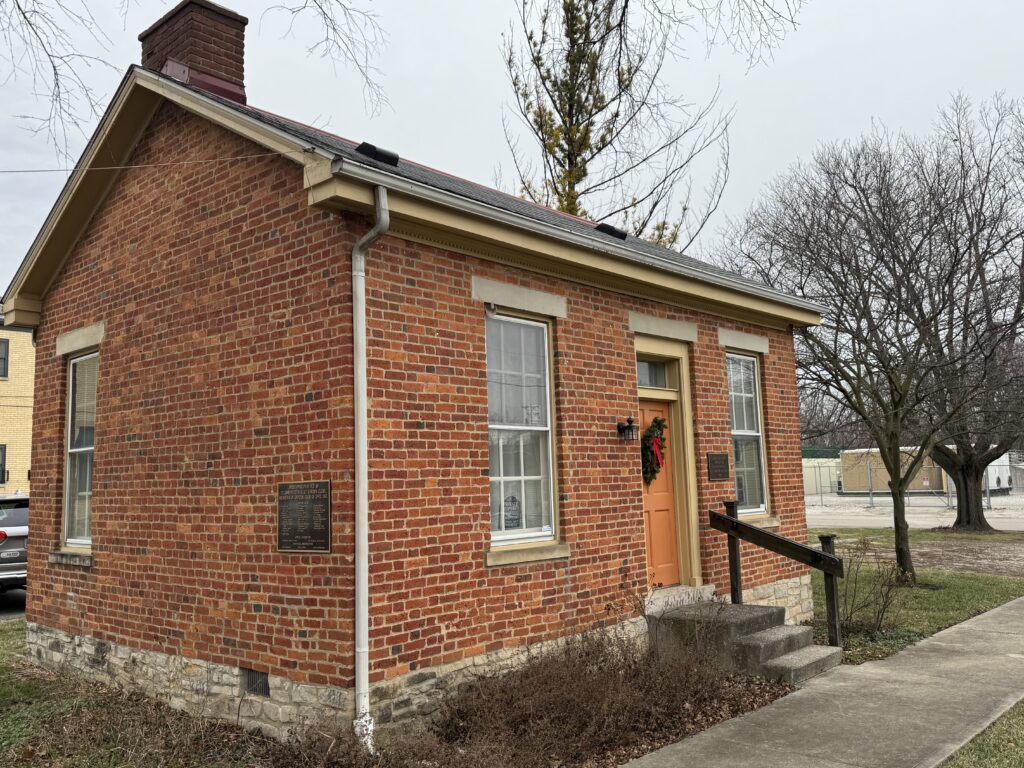
His land office, built in 1822, sits at 13 North Gift Street in Franklinton and is still standing today. The city of Columbus transferred ownership of the property to the Columbus Historical Society in 2021. The building has been restored to an early 1800s land office and is used for educational purposes.
In 1775, the legendary frontiersman Daniel Boone discovered the Wilderness Road through the Cumberland Gap, thus opening land we now know as Kentucky. He is widely considered the state’s founding father. It takes a special kind of person to venture out into the unknown, carve away the wilderness despite the dangers, build a life for yourself and then invite your family and friends. Lucas Sullivant did just that.
He’s our Daniel Boone.
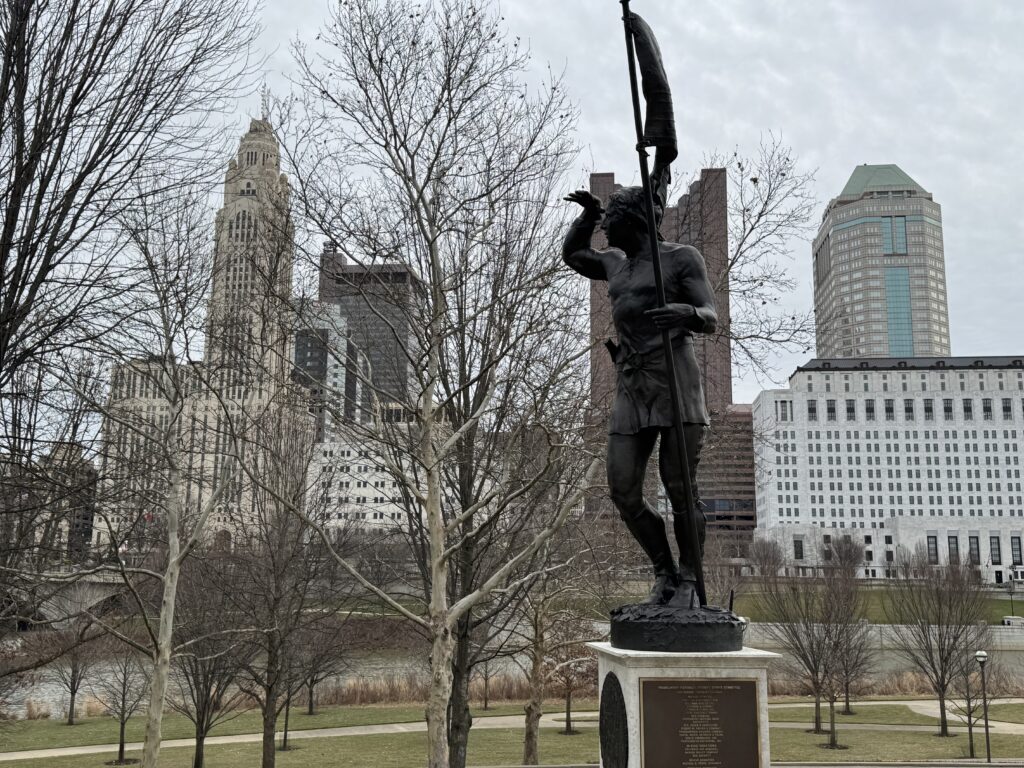
Sources: Columbus – the story of a city by Ed Lentz, 2003; A historical guidebook to old Columbus by Bob Hunter, 2012; Columbus – America’s Crossroads by Betty Garrett w Ed Lentz, 1980; Columbus Neighborhoods – A guide to Landmarks by Tom Betti, Ed Lentz and Doreen Uhas Sauer, 2013; Lucas Sullivant, City of Columbus, www.columbus.gov; Franklinton historical marker to be restored by Tyler Buchanan, July 20, 2023, www.axios.com; As It Were by Ed Lentz, 2013; Harrison House and Sullivant Land Office, Columbus Historical Society, www.columbushistory.org; History Lesson: Lucas Sullivant, Pioneer of Franklinton by Doug Motz, Jan 17, 2012, www.columbusunderground.com; Daniel Boone, Biography, American Battlefield Trust, www.battlefields.org; Daniel Boone’s Kentucky, www.kentuckytourism.com; www.america250-ohio.org; As America turns 250, embrace all our history, warts and all by Todd Kleismit, Guest Columnist, Dec 9, 2025, www.dispatch.com; The featured picture is the Lucas Sullivant statue dedicated on May 6, 2000. It sits on the west bank of the Scioto River very near where he founded Franklinton in 1797.