
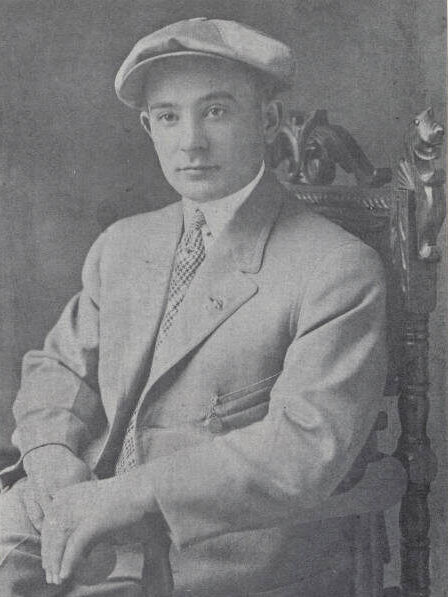
Salvatore felt the pull early in life to make his way to America, despite growing up an ocean away. After surviving a treacherous Atlantic Ocean boat trip here, his life challenges were just beginning. Sal landed in New York and lived on the streets as a teenager. He survived a career choice fraught with danger, a deadly generational flood, Prohibition that killed a business, and the Great Depression.
At 13, despite his father’s strong objections, Salvatore Presutti purchased a $15 ticket on the aging French steam ship Politio for the four thousand mile trip to the United States. His mother had died when he was eight. Salvatore was the tenth child. His family lived in a small Italian farming village.
His father cried as he saw him off. They would never see each other again.
The ship left Naples on Feb 6, 1903 and arrived in New York harbor on Feb 28. There were two hundred immigrants on the boat. Salvatore was part of the ship’s crew of ten. This would be the last voyage of the Politio. It struggled in its 23-day voyage (typically a 14-day trip) across the Atlantic, nearly capsizing on more than one occasion.
Then, confusion at Ellis Island. America did not know what to do with this young Italian boy who was all by himself. He was detained for five days until a prominent Italian banker stepped in. Finally, Salvatore was able to make his way to ‘Little Italy’ in New York. There, he found a place to stay for $8 per month and began shining shoes and selling newspapers. Young Sal quickly developed a survival instinct.
In 1906, he joined the circus and left the city. It was solid work for the spring and summer as the circus travelled throughout the east and midwest. After a stop in Columbus, Ohio – when the circus left town – he decided to stay.
At 19, while working as a dishwasher at Goodale & High, his work ethic caught the eye of Carl Hoster, a prominent local businessman. Sal was given the opportunity to open his own restaurant, The First and Last Chance Saloon in Flytown (now Grandview). Hoster had purchased an old run down saloon at 519 West Goodale St for $100.
The bar drew a rough crowd. There were bullet holes in the ceiling. Salvatore had to hire a bouncer, so he approached a local prize fighter by the name of Fritz Wentzell. When asked how much was the pay, Sal replied, how much do you want? Wentzell wanted $20 and three cases of beer a week. Though extravagantly high, he agreed.
Fritz earned his money. On Saturday nights Sal would roll out 15-gallon barrels of beer with Fritz stationed by the door prepared for the onslaught of drinkers.
There would be amateur wrestling matches and always an unplanned but entertaining toe-to-toe fist fight. Fritz would eventually end the fights by pitching both participants out the door.
Sal would carry a .38 caliber gun with him at closing. He would stuff all the money from the night’s receipts into a bag and walk down the middle of the street with his gun drawn all the way home.
The Great Flood of 1913 hit in late March. Within forty eight hours, nine inches of rain had fallen. Goodale St became a river, and the saloon found itself in six feet of water, but it survived.
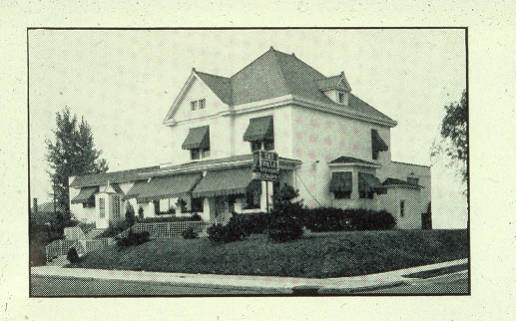
Columbus Metropolitan Library.
Salvatore married Rosina Gualteri in October 1914. His father had pre-arranged the marriage. She had arrived from Italy the year before. At the reception, nine 15-gallon barrels of beer was consumed.
They bought a home at 737 Pennsylvania Ave for $1750 and started a family. Alfredo was born in 1915, Edna in 1916 and Evelyn in 1920. Soon they needed a larger home and moved to a large brick house on West Fifth Ave. They planted a garden in the back.
In 1919, Prohibition became law. ‘The First & Last Chance Saloon’ did not survive.
Salvatore tried his hand at the grocery business. It did not go well. Out of desperation to feed his family he took a shot selling bootleg whiskey. He even took a secret overnight trip to Michigan to purchase thirty gallons of contraband. He eventually got caught by the police and was forced to pay a stiff fine.
Salvatore tried to sell his home on West Fifth Ave, but even with an eight foot sign in his front yard for two years, the couple had no offers. It was 1932. Rosina then convinced Salvatore not to sell the home but convert the bottom half into a restaurant. The bank agreed.
The Presutti children worked in the new restaurant seven days a week. Rosina was a natural with the guests and Salvatore made sure the people got their money’s worth. The décor was over-the-top, like being invited to a huge Italian wedding.
The business kept growing. The restaurant kept expanding, tripling in size. They changed the name to Presutti’s Villa. They added a beer garden in the back, two large dining rooms with red tablecloths, a Friday night fish buffet and a bake shop.
With the business humming, Salvatore – affectionately called ‘Papa’ – and Rosina decided to return to Italy to visit family in 1960. For Pappa it had been 57 years since he’d been back. They visited Rosina’s brother and the grave of Sal’s parents’ Raphael and Giovanna. Rosina died three years later.
In August 1975, the Presuttis celebrated Papa’s 86th birthday. “I cannot help but reflect on my first impression of America as I looked from the rail of an old steamer at the Statue of Liberty – our lady of the harbor shrouded in an early morning fog,” Papa said with the help of a friend. “When I saw her then, I whispered a prayer of gratefulness. Now, today I whisper that prayer again. Not for me, but for the children of my grandson, and for his children, and for the generations of American citizens yet unborn.”
Salvatore died three months later. He is buried in St. Josephs Cemetery alongside Rosina.
In 1980, a kitchen fire broke out. After nearly fifty years, the era of an iconic and beloved Columbus eatery had passed.
The life of Papa Presutti is a story of hard work, perseverance, and family. His words ring true still today. We should all be whispering our prayer for this country and our incredible immigrants who, in the words of former president Ronald Reagan, “came to America with a firm willingness to work, asking only freedom.”
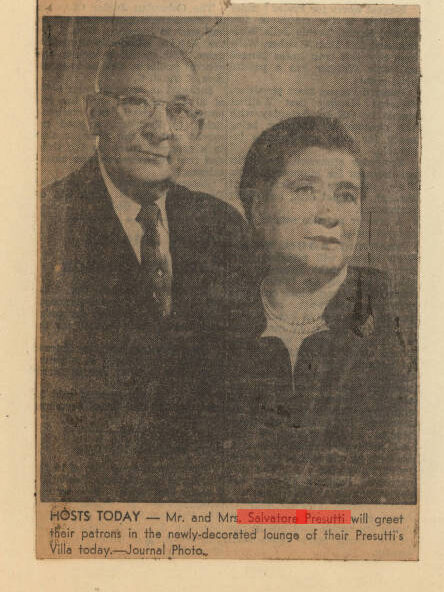
Sources: Columbus Italians by Andy & Erin Dominianni; Lost Restaurants of Columbus Ohio by Doug Motz & Christine Hayes, 2015; Columbus 1910 – 1970 by Richard E Barrett, 2006; Italian Restaurants, Part 1 by Vivian Witkind, Columbus Monthly, April, 1976; Passage to America – the life of Salvatore ‘Papa’ Presutti by Mike Harden; Salvatore Presutti, www.findagrave.com; Presutti’s Villa – Grandview Heights/Marble Cliff Historical Society, August 8, 2000, www.ghmchs2.org; Papa by Mike Harden, Jan 1976, Columbus Monthly; www.reaganfoundation.org; Featured picture is from Columbus Monthly, Jan, 1976, courtesy of the Columbus Metropolitan Library.