
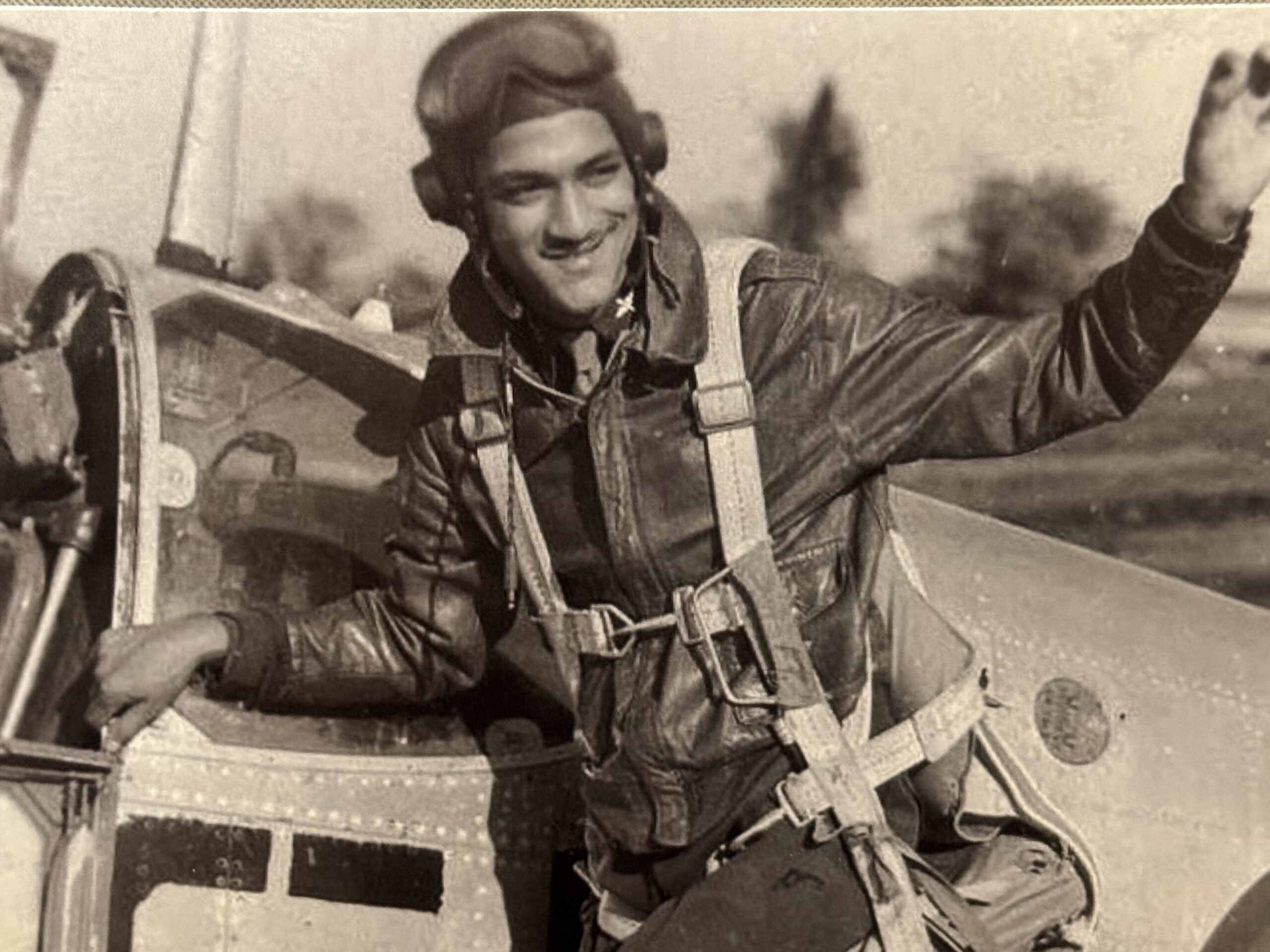
All aviation cadets were required to have at least two years of education and to pass a physical exam. Harold Sawyer from Columbus, Ohio, who was a quiet & gentle man, was under weight. After two failed exams, the doctor said “next time, get a sack full of bananas. Eat them on your way here and drink all the water you can.” He passed his next physical.
Harold Sawyer graduated from Central High School in 1938, the Tuskegee Institute in Alabama in 1942 and became second lieutenant after successfully completing the CPT (Civilian Pilot Training) program.
There were 926 Black Americans from all over the country enrolled in the U.S. Army Air Corps program. They experienced firsthand the “naked racism in the south as opposed to the veiled racism in the north.” Lynching was still a regular occurrence in the south during the war. Pilots trained in both fighter planes and medium bombers. The planes they flew – the P-39 Airacobra and the P-40 Warhawk – were outdated.
Harold was assigned to the 301st Fighter Squadron and flew the P-39, performing coastal and harbor patrol.
Benjamin O Davis, an African American and West Point graduate, began training pilots in the summer of 1941. He had graduated 35th in his class of over 200. In less than two years he was promoted to lieutenant commander of the 99th Pursuit Squadron, the US military’s first all black fighter squadron.
Davis was later promoted to Colonel of the 332nd fighter group. Some whites argued to shut down the all-black 99th. Davis appeared in front of a War Dept committee to plead the case of the 99th who were operating inferior aircraft and doing well. The committee agreed and upgraded the 99th to the newer P-47 Thunderbolts and the P-51 Mustangs. That’s when they decided to paint their tails red.
Harold Sawyer was the first of the group to down two enemy fighters on July 12, 1944, in his P-51.
German fighter planes began zeroing in on U.S. B-17 and B-24 bombers. With every plane loss, ten highly trained crewmen were lost as well. Bomber escort fighter planes quickly became in high demand.
Davis’ strategy was to escort only. He told his team not to chase German planes because that was part of their strategy to draw the escorts away.
Tuskegee escort fighters lost only 27 bombers, well below the average of 46 bombers lost by other escort squadrons. Bomber squadrons started requesting the red tails.
“Protecting the bombers, there was no other squadron during WWII that even matched their record,” says John C Mitchell, former president of the Tuskegee Airmen, Inc., Ohio Memorial chapter.
The Redtails (332nd) would fly their longest mission of the war on March 24, 1945, escorting a bomber flight to Berlin. They were attacked by thirty German ME-262 fighters, the first jet fighter. The Redtails engaged and broke up the attack and bagged three of the jets, including two flown by German aces.
After the war, Harold Sawyer returned home to Columbus, got married and bought a home in Eastgate. He took advantage of the GI Bill, went back to school for mechanics and HVAC and got a job with the Columbus Metropolitan Housing Authority.
Columbus won out at war’s end in 1945 when the US Army Air Corps (renamed the U.S. Air Force in 1947) assigned most of the 332nd Tuskegee Fighter Group Squadron to the Lockbourne Air Base (later renamed Rickenbacker). The military was segregated, so rather than spread them out all over the country, the decision was to send most of them to a single base thereby avoiding building Jim Crow facilities at all bases across the country. Columbus was selected over Hartford, Connecticut because of good race relations and plentiful housing.
Many credit the Columbus experience as being a big factor in President Truman’s decision to end military segregation on July 26, 1948, with Executive Order 9981. It mandated “equality of treatment and opportunity in the armed forces.”
Wartime commander Benjamin O Davis Jr later became the first African American general in the United States Air Force.
Sixty six Tuskegee Airmen did not make it home from the war.
There were more than 350 pilots in the group who flew over 15,000 sorties, 1491 combat missions, shooting down 112 enemy planes while being supported by thousands of ground crew and staff. Among their awards, the Tuskegee Airmen earned 96 Distinguished Flying Crosses, 14 Bronze Stars, 744 Air Medals and eight Purple Hearts.
Captain Harold Sawyer died on June 22, 2002. He was 82.
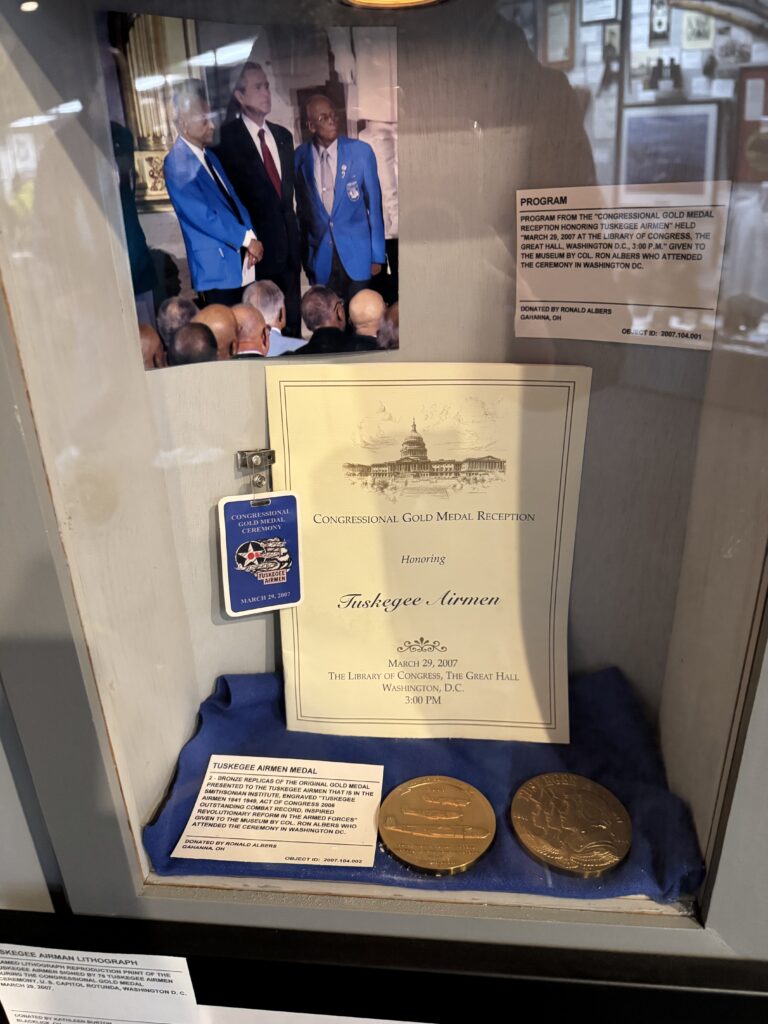
In 2021, Ohio established March 29 as Ohio Tuskegee Airmen Day, dedicated to recognizing the courage, sacrifice, and achievements of the airmen who changed history.
After the war, the Tuskegee Airmen top guns won the first aerial gunnery competition in May 1949 but never received their trophy. In a ceremony in 2022, seventy three years later, at the American Veterans Center in Arlington, Virginia, Colonel James H Harvey III was finally presented the trophy. It is now on display at the National Museum of the United States Air Force, just outside Dayton.
There is a Tuskegee Airmen display at the National Veterans Memorial & Museum in Columbus and at the Motts Military Museum in Groveport.
“What I often marvel at, is that they were not bitter. They didn’t hold that against America,” says Evelyn Kelley Antione, vice president of the local Tuskegee Airmen, Inc, Ohio Memorial chapter. “God allowed a lot of them to have longevity to see America say thank you.”
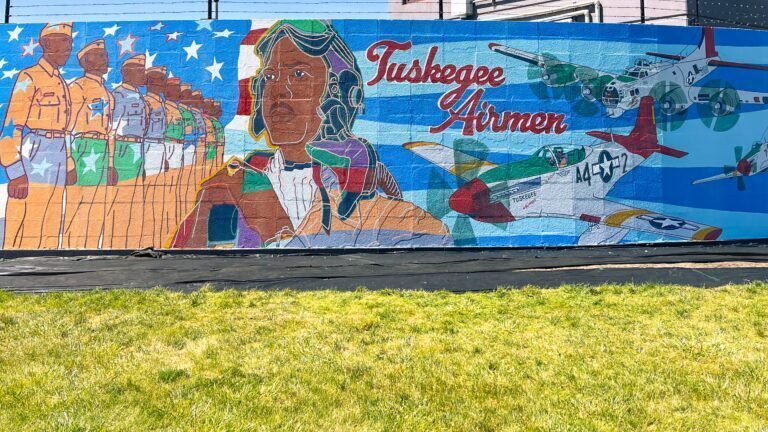
Sources: www.america250-ohio.org/murals-across-ohio/; Tuskegee Airmen – Ohio Memorial Chapter, Too Blessed 2be Stressed Ministry, www.tuskegeeairmenomc.com; Tuskegee Airmen – City of Columbus, Ohio, https://www.columbus.gov; How the Tuskegee Airmen Ended Up at Columbus’ Lockbourne Air Base After WWII by Jeff Darbee, Sep 26, 2022, www.columbusmonthly.com; Tuskegee Airmen, the Ohio Bicentennial Commission, Tuskegee Airmen, Inc, The Ohio Historical Society, 2003; Tuskegee Airmen display, National Veteran’s Memorial & Museum, Columbus, Ohio; How the Tuskegee Airmen proved the military wrong, American Veterans Center, Oct 31, 2025, www.youtube.com; The Tuskegee Airmen, US History, WWII, Extra History, June 28, 2025, www.youtube.com; How Eastgate became home to Tuskegee Airmen and their families by Nora Igelnik, Feb 12, 2024, www.wosu.org; The inspiring legacy of the Tuskegee Airmen, Feb 28, 2023, www.flycolumbus.com; George E Hardy, one of the last surviving Tuskegee Airmen dies at 100 by Kevin Dupuy, Sept 26, 2025, www.nationalww2museum.org; Columbus Neighborhoods: Columbus’ Link to the Tuskegee Airmen, Nov 4, 2016, WOSU Public Media; On this day in Columbus Ohio history by Tom Betti & Doreen Uhas Sauer, 2013; Harold E Sawyer collection, Ohio History Connection, www.aspace.ohiohistory.org; ‘After the War’, Interview with Mrs Harold Sawyer, 2013, www.youtube.com; Tuskegee Airmen display, Motts Military Museum, Columbus, Ohio; Featured picture is a mural dedicated in June 2024 to the Tuskegee Airmen at Rickenbacker Air National Guard base in Lockbourne.