
Sixty-year-old resident and local legend Frank Fetch bought a home on Columbus’ heavily German south end in 1959 when nobody else would. The area was caught in the throes of highway construction, urban renewal and industrial expansion. Streets were torn up. Houses and businesses had disappeared. There were unkempt homes, some of which were vacant and boarded up. Urban blight was in full bloom.
Fetch bought his new home with the intention of restoring it. Which he did. Then it made the local paper. A preservation buzz was generated. Frank decided to host a meeting and invite the public. Two hundred people showed up and soon, the German Village Society was created.
In the summer of 1960, GVS organized its first German Village Haus and Garden tour to showcase the neighborhood. Also showcasing the neighborhood was Oktoberfest, which at that time was held at Schiller Park, in the heart of German Village. The village received a lot of looks.
By the end of the ‘60s, preservation efforts had gathered steam. A remarkable revival ensued. Looks became buyers. In July 1967 Schmidt’s Restaurant & Sausage Haus opened. Founder George F Schmidt threw his support behind the Germania Oktoberfest at Schiller Park.
By 1970, however, neighborhood complaints about the beer cans and the noise of Oktoberfest began to mount. Despite playing its part in the village’s revival, the event was forced to move on. In 1972, the decision was made to move it to the Ohio Expo Center, a larger venue with parking and 100,000 square feet of indoor space.
Oktoberfest in Columbus suddenly went from a charming neighborhood celebration to a regional exposition. Something was gained, but something was lost.
Fast forward to the mid-1980s. After twenty odd years and three different venues, organizers found themselves at a crossroads. Again. Enter another pair of local legends, Fred Holdridge and his partner Howard Burns. The two, by then were twenty-five-year residents of the village and were trusted voices in guiding the good ship USS German Village.
Holdridge, along with Aaron Leventhal, personally appointed by George Schmidt, were instrumental in bringing Oktoberfest back to German Village in 1986. Leventhal was able to line up sponsors, entertainers, vendors and more than a thousand volunteers. The event moved to the Brewery District and was an overwhelming success. Proceeds helped raise money to purchase a small meeting haus for the German Village Society and to hire the neighborhood’s first preservation officer.
Unfortunately, Oktoberfest didn’t stay there long despite its success. For ten years beginning in 1990, Oktoberfest was actually held in a vacant lot on the corner of Grant and Livingston Avenues. Any and all of its German charm was gone. It was in German Village, but in name only.
Fred – in his neighborhood’s defense – wrote a letter to Columbus Monthly complaining that German Village had been removed from Oktoberfest. He criticized the media’s coverage of the event, even though, for the 1990s Oktoberfest in Columbus – in a vacant lot – was just a festival.
Leventhal served fifteen years as director of the Oktoberfest which, during his tenure, was named one of America’s Top 100 events in North America by the American Bus Association. He raised more than $2 million for the German Village Society and was inducted into the Columbus Oktoberfest Hall of Fame in 2012.
The event survived the 90s. Meanwhile, by 2000, German Village was no longer the struggling neighborhood of the 1960s. It had become a highly desirable historic district. Property values had trended upward, and available festival space was sparse. Over the next nine years, Oktoberfest bounced between four different venues – the Brewery District, back to the vacant lot, the Arena District and even Genoa Park.
In July 2009, because of staffing shortages, it was decided that Oktoberfest that fall would be cancelled.
At that point, with just eleven weeks to pull it off, the Schmidt family stepped back in. Carla Epler, COO for Schmidt’s Restaurant and Sausage Haus and a 2021 Oktoberfest Hall of Fame inductee, was part of the team along with Geoff Schmidt that saved the Columbus Oktoberfest. Carla served as executive director for fourteen years.
This weekend, Columbus proudly celebrates the 60th anniversary of its Oktoberfest. The tapping of the keg is Friday, September 11 at 6:15pm. “O’zapft is!” The first night also features the Meiler Vier, a four-mile run and Columbus Oktoberfest Hall of Famers The Klaberheads from Hamilton, Ohio, who take the stage in Heidleberg Hall. The Gemütlichkeit Games are scheduled for Saturday afternoon, concluding with the Steinheben (highest lift of a 508-pound stone) at 7.
Oktoberfest in Columbus – in a small way – helped save German Village, its home. German Village became a success, as we all know, so much so that the neighborhood charm it embodies likely will never again host the very event that celebrates its heritage.
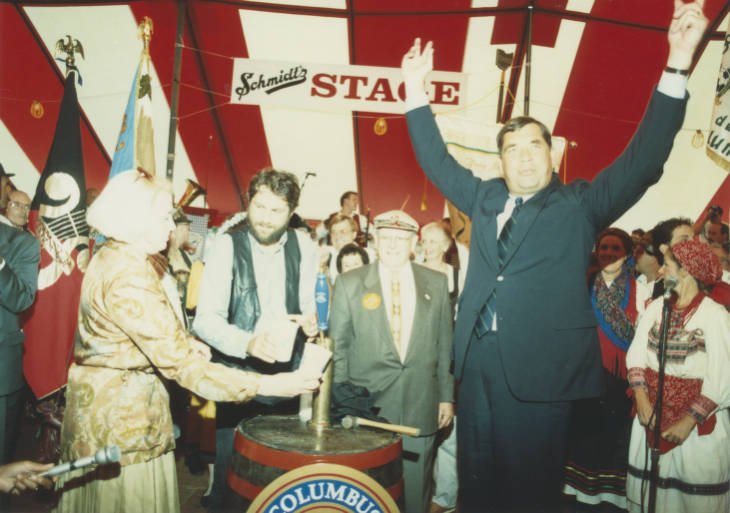
Sources: Columbus Oktoberfest / Schmidt’s Annual German Celebration, https://schmidthaus.com; www.ohioexpocenter.com; Columbus Oktoberfest by Loraine M Wilmers, Sep 2020, Columbus Historical Society, www.columbushistory.org; On this day in Columbus Ohio by Tom Betti & Doreen Uhas Sauer, 2013; Hall of Fame, www.columbusoktoberfest.com; Six Oktoberfests you can’t miss by Theresa Russell, Sep 7, 2018, www.ohio.org; Columbus Neighborhoods: German Village, Oct 10, 2010, WOSU, pbs.org; www.germanvillage.com; The founders of Hausfrau Haven created a safe space in German Village by Aaron Marshall, Jan 14, 2026, www.columbusmonthly.com; Frederick Holdridge Obituary, www.legacy.com; Letters / Oktoberfest, Nov 1991, Columbus Monthly, www.digital-collections.columbuslibrary.org; History of Oktoberfest, www.oktoberfesttours.com; The rich history of Oktoberfest: from royal wedding to global celebration, www.shipgarten.com; A journey through the history of Wiesn, www.oktoberfest.de; George Schmidt Obituary – Columbus, OH, www.dignitymemorial.com; Featured picture is of the 1992 Oktoberfest keg tapping with then Columbus mayor Greg Lashutka. The short man next to him is the legendary Fred Holdridge. Courtesy of the Columbus Metropolitan Library.