
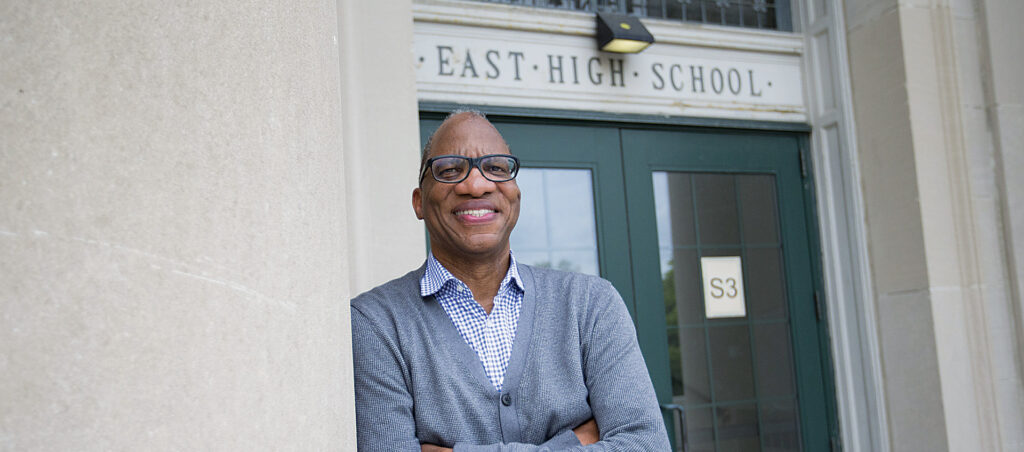
In 1976, fresh out of Miami University with a degree in Urban Planning, Wil Haygood moved back to Columbus. His family was here, but his 2.1 GPA wasn’t exactly making the phone ring. He started filling out job applications, knew he loved to write and decided to put in an application at the Columbus Call & Post.
Wil recounts the story of his first job interview with Amos Lynch, the newspaper’s legendary editor: “Didn’t you work for your college newspaper?” Lynch asked. “I told him I did not work for my college newspaper, and right then and there I wanted to leave. Then the phone rang. And when the editor hung up the phone, he explained to me that a housing grant was being announced downtown in two hours. I was to go cover it. This was my tryout. I’d better leave now, he said, and I did.” Haygood wrote up his story and turned it in.
Six weeks later Lynch called to offer him the job.
Wil Haygood fell in love with writing while in Weinland Park Elementary School on Columbus’ north side in the 1960s. A teacher noticed. He began going to the library. And reading. Wil would go on to travel the world writing for the Boston Globe and later for the Washington Post.
Wil and his twin sister Wonder Haygood were born September 19, 1954 in Columbus, Ohio. Wil was one of five children. His parents got divorced when he was 2. His mom was young. They all moved in with their grandparents Jimmy & Emily. The family didn’t own a car.
While Wil’s grandparents were his role models growing up, he credits his older sister Diane with holding the family together. Despite his advice for her to leave Columbus like he did, she stayed put providing a gathering place for the family to come home to over the years.
Wil had a legal guardian – Odell Wilson. He also had delusional dreams about playing basketball. He did play varsity for Franklin Heights High School though he didn’t get in much. Odell never missed a game. Odell also happened to be the father of the great jazz singer Nancy Wilson. Nancy was 17 years older than Wil and had long since left Columbus.
During his brief 11-month stay at the Columbus Call & Post – a local weekly newspaper – Wil got to cover the Buckeyes – the year Woody got fired. He also covered boxing at the Fairgrounds Coliseum. He got to know & cover Bill ‘Dynamite’ Douglas, the father of eventual world heavyweight champion Buster Douglas.
Soon he would move on to the Pittsburgh Post Gazette and then in 1985 he landed his dream job as a foreign correspondent with the Boston Globe.
Wil has written nine non-fiction books beginning in 1986 with the release of ‘Two on the River’. He wrote ‘The Haygoods of Columbus’ in 1997 and in 2018 he released ‘Tigerland’’, about the Tigers of Columbus East High School and their resolute run to the state basketball & baseball championships in 1968 amidst the country’s heightened racial tension following the assassination of Dr Martin Luther King, jr.
In 2008, Haygood wrote an article in the Washington Post about Eugene Allen, a butler at the White House for 34 years serving eight different presidents. For a writer, this was a game changer.
Soon the article became a book ‘The Butler’ and was released in 2013. Haygood went on a 40-city book tour to promote it. ‘The Butler’ was released as a movie the same year starring Forest Whitaker & Oprah Winfrey. It grossed a disappointing $177 million worldwide.
Haygood was a Pulitzer Prize finalist while working at the Boston Globe. He is an important cultural historian of our day. Through his writing we see and feel the struggles of our black neighbors. Segregation in housing, schools and employment was a powerful & devastating weapon wielded by white America in the 1960s and 1970s even after successful passage of civil rights legislation.
Wil Haygood was chosen as the James Thurber fellow at the Ohio State University in 1994 where he was a resident for a year. He has been awarded the prestigious Guggenheim fellowship, the National Endowment for the Humanities fellowship, Ella Baker Social Justice Award, an Honorary doctor from his college alma mater and he was the first person enshrined in the Lincoln Theatre’s Walk of Fame in Columbus.
Wil’s career has been dedicated to telling the real story of black American history. He has chronicled the lives of historically important black leaders such as Congressman Adam Clayton Powell Jr., in ‘King of the Cats’ (1993); Sammy Davis jr, ‘In Black and White’ (2003); and Sugar Ray Robinson ‘Sweet Thunder’ (2009). In some circles this is considered the African American trilogy of its day.
Haygood credits his book ‘Showdown’ (2015) about Thurgood Marshall’s nomination to the US Supreme Court for his being recognized as a fellow of the John Simon Guggenheim Memorial Foundation.
Haygood’s most recent book ‘Colorization – one hundred years of black films in a white world’ was released in 2021.
Wil Haygood’s time in Columbus has stayed with him as he has travelled the world. He has spoken to the City Readers, a program for young students that encourages reading (started by former Mayor Michael Coleman).
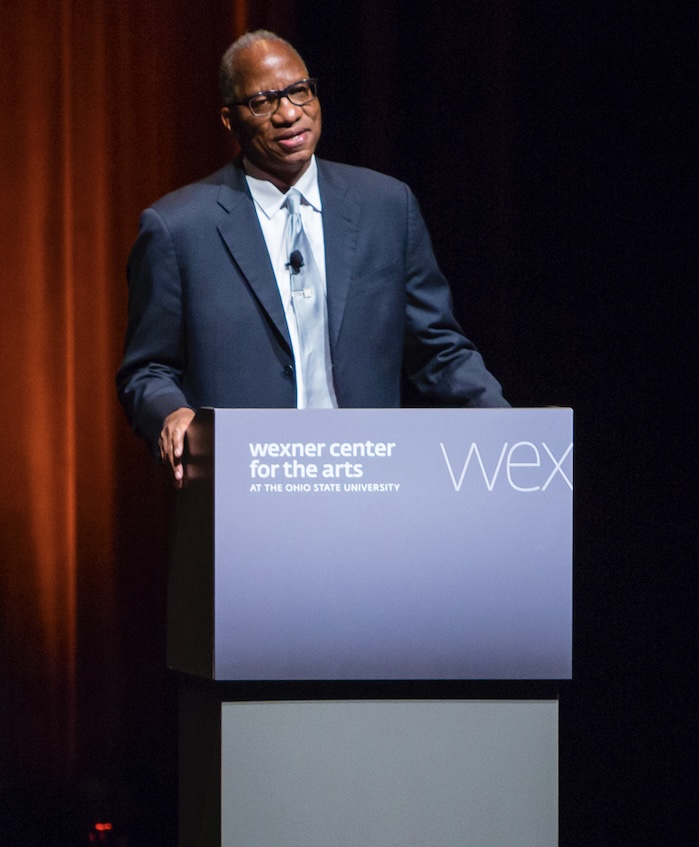
He spoke at the Wexner Center for the Arts in 2021 promoting his book and at the James Thurber House in Columbus in June, 2024.
Haygood currently lives in Washington DC. He just turned 70 last fall. Maybe another Columbus specific book is still in him.
Sources: Haygoods of Columbus – A love story by Wil Haygood (1997); Tigerland by Wil Haygood (2018); Columbus Neighborhoods: A guide to Landmarks by Tom Betti, Ed Lentz and Doreen Uhas Sauer 2013; Columbus Monthly ‘Wil Haygood’s Forgotten book May 10, 2017; MiamiOh.edu/Wil Haygood bio; www.gf.org/fellows/wil-haygood/; www.wgbh.org/people/wil-haygood; https://wexarts.org/talks-more/tigerland-columbus-intersection-sports-and-race#images-preview-1; www.ohioschoolboards.org/osba/proud-products/view/93; www.asja.org/author-wil-haygood-on-black-and-white-america/; Wexner picture courtesy https://wexarts.org/; East High School picture courtesy the Columbus Metropolitan Library.