
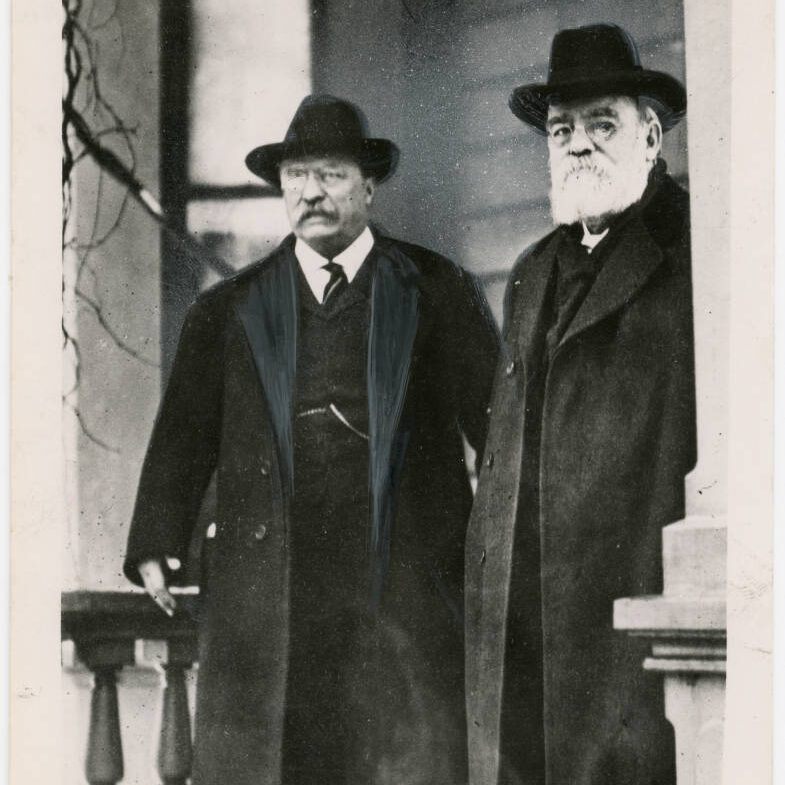
It was your typical cold, gray and sleety February morning in Columbus. Charismatic former president Teddy Roosevelt arrived by train at Union Station to deliver a speech to the members of the Ohio constitutional convention and more than a thousand people were on hand to greet him.
Roosevelt’s host that day – February 21, 1912 – was Reverend Washington Gladden who greeted him when he got off the train, sat next to him in the state capital chambers as he delivered his speech and hosted him at his home for a luncheon afterwards.
Dr Washington Gladden was “the most celebrated minister the city ever had,” according to local historian Bob Hunter. Gladden was minister at the First Congregational Church in Columbus from 1882 to 1918 and he was nationally known for his Social Gospel movement. Gladden’s presence made Columbus a destination for presidents and religious leaders.
Washington Gladden was born in 1836 in Pottsgrove, Pennsylvania. He did not make his way to Columbus until he was 46 years old.
His father died at age 6. He lived with his uncle on a farm near Owego, NY. Western New York at that time was known for religious revivals. Washington learned as a teenager that religion is “summed up in the word friendship…with the father above and brother by our side.”
He graduated from Williams College in Massachusetts in 1859 and his career path would bounce back and forth from church pastor to writer. He was polished at both when he arrived in Columbus, Ohio.
Gladden was ordained by the Congregational Church in Brooklyn in 1860 and married schoolmate Jenni Cohoon in December of that year. They would have two daughters and two sons together.
In 1871, he became religious editor of the New York Independent – a weekly national newspaper with a circulation of one million. Gladden wrote forty books and hundreds of poems, hymns & articles. He wrote on social issues and gained fame. In 1876 he published ‘Working People and their Employees.’
A couple of years before arriving in Columbus, Gladden wrote ‘Being a Christian & How to begin’ – a life changingroad map to God. “Trusting a being of perfect truth should be the easy part,” he says in the book. “Following Him or upholding our end is the hard part.”
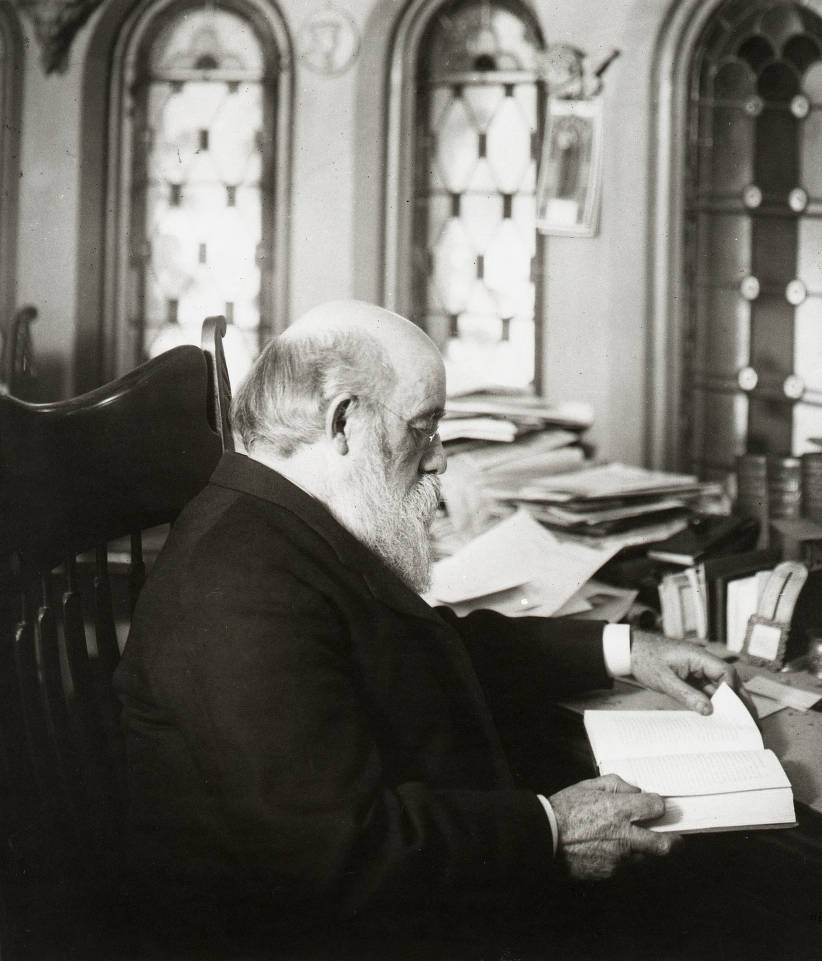
Gladden’s Sunday evening sermons in Columbus were passionate and progressive. He thought it despicable that a country of wealth such as ours still had to deal with the sad plight of poverty. He also preached on behalf of the working man and the evils of big business. His words were published and gained a national following.
Reverend Gladden’s philosophy to apply Christian law to social problems became his ‘Social Gospel Movement’ in the early 1900s. He felt Capitalism could & should be reformed to better reflect Christian principles. It grew into a national movement that advocated civil rights, worker’s rights, voting rights, religious pluralism, school integration and the needs of the poor and oppressed.
The attendance at Reverend Gladden’s Sunday sermons became quite large and his congregation grew. The church – then at 74 E Broad St – built an expansion in 1914 and eventually moved to its present location in 1931. Unfortunately, Gladden would not be around to see it.
Washington served as president of the American Missionary Association which supported higher education and voting rights for African Americans. He was a member of Columbus City Council from 1900-1902 and advocated municipal ownership of public works. He joined Reverend James Poindexter of the Second Baptist Church to convince the Columbus Public Schools to adopt a school integration model.
Washington was commencement speaker at the Ohio State University in 1910. He was “one of the most remarkable men ever produced by Columbus,” according to local historian Betty Garrett.
Dr Gladden was presented with a tiller-steered electric automobile in 1910 by his congregation.
Washington Gladden died on July 2, 1918. He is buried at Greenlawn Cemetery in Columbus.
The Gladden Community House continues to serve Franklinton area communities. It was founded by Gladden in 1905 to provide pre-school, senior citizen outreach, summer camps and even rent assistance to the less fortunate.
The massive First Congregational Church (built in 1931) – at 444 E Broad Street – houses Gladden’s original pulpit (from 74 E Broad St).
Gladden lived at 623 East Town St in Columbus from 1890 until his death in 1918. His daughter Alice left the house to the Columbus School for Girls upon her death in 1926. The house was eventually razed when I-71 was constructed.
Washington Gladden Social Justice Park opened in 2018 (one hundred years after the reverend passed) right next to the First Congregational Church downtown. It was the first of its kind in the U. S.
On a bitterly cold January afternoon in 2025, Washington Gladden Park hosted an MLK Day program where some 50-60 brave souls bundled up and made it out to the park to honor, remember, praise, cherish, and show love for the great Martin Luther King jr. Local speakers talked about the work ahead including the church’s interim pastor and a couple of board members. The big bonus of the afternoon was a riveting speech by 9-year-old Elias Jones Burk on the legacy of MLK. He had come out with his father to practice in front of a live audience for an upcoming competition.
The main tenets of the Social Gospel movement eventually influenced the passage of the landmark Civil Rights Act of 1964.
Sources: A historical guide to old Columbus by Bob Hunter; On this Date in Columbus Ohio history by Tom Betti and Doreen Uhas Sauer for the Columbus Landmarks Foundation 2013; Columbus: America’s Crossroads by Betty Garrett; Columbus Historical Society, January 2017; Being a Christian by Washington Gladden; Columbus Neighborhoods: A guide to landmarks by Tom Betti, Ed Lentz & Doreen Uhas Sauer (2013); Admirers turn Roosevelt’s visit into big personal triumph, Columbus Evening Dispatch, Feb 21, 1912; Columbus – the story of a city by Ed Lentz, 2003; Columbus Vignettes by Bill Arter, Vol III, 1969; ‘The Social Gospel Movement’, Professor H’s Land of Wisdom, YouTube, 2000; www.socialjusticepark.org; Featured pictures courtesy of the Columbus Metropolitan Library.