
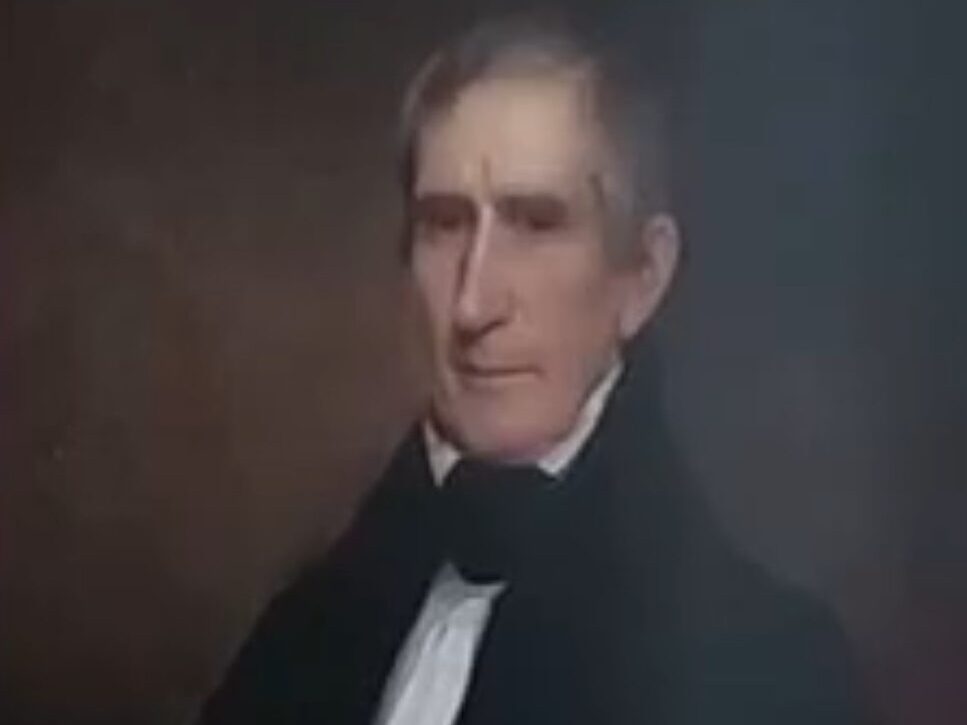
Virginia native William Henry Harrison was governor of the Indiana territory for twelve years. His main job responsibility was to fight Indians.
Legendary Shawnee Chief Tecumseh was busy building a coalition of Indian forces to fight the expansion west of the Euro-Americans. And the British Royal Navy was encroaching upon American maritime rights to control the world’s oceans and therefore its trade.
With tensions & violence increasing, Governor Harrison marched an army of one thousand men to Prophetstown, Indiana in November 1811 with the plan of attacking the Native American headquarters near the confluence of the Tippecanoe and Wabash Rivers. Harrison’s forces set up a meeting with Tecumseh’s brother for the following day. To their surprise they were attacked early the next morning. The Americans not only held their ground but burnt Prophetstown to the ground and destroyed the food supplies stored for the winter.
Tecumseh’s confederacy would never be the same. The War of 1812 officially began in June, with the U.S. declaration. William Henry Harrison was commissioned as a general in the army.
Columbus, Ohio had just been founded at the confluence of the Scioto and Olentangy Rivers. Franklinton served as a mobilization and supply center. British prisoners were soon marched to Columbus and held captive on a sandbar in the middle of the Scioto River.
The war did not start well for the Americans. U.S. General Hull surrendered Detroit without a fight in August 1812. Everyone naturally thought an attack on Ohio was imminent. Harrison began recruiting town-to-town, gathering supplies, arms and men. His army cleared land and built forts across the state about thirty miles north of Columbus, while also building cabins and bridges. A stockade and defensive ditch was dug around the courthouse.
With Detroit, the British had seized control of Lake Erie. If America were to win, they needed to regain control of the waterways and make sure the local Native Americans weren’t going to be siding with the British.
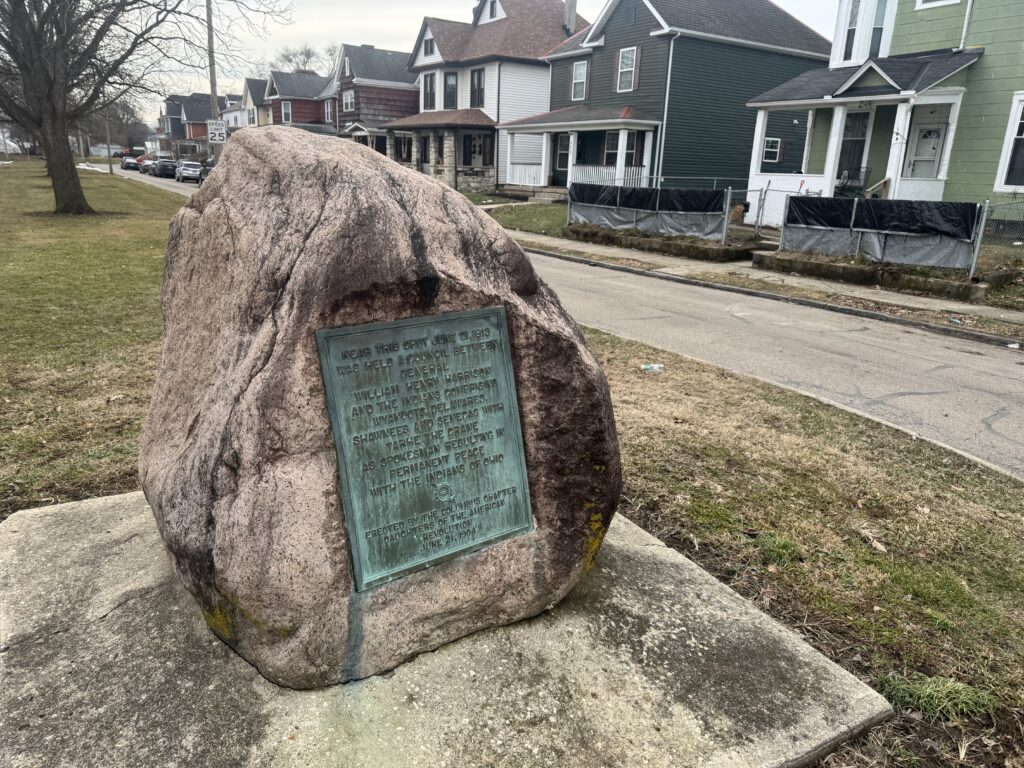
“Beneath an (old elm) tree, General William Henry Harrison made a speech to a large assembly of Indian chiefs in 1813, a speech that may have meant victory over England in the War of 1812,” wrote Columbus historian Bob Hunter. On June 21, Harrison and the leaders of four major tribes – the Wyandots, Delaware, Shawnee and Seneca – met in Lucas Sullivant’s backyard. The tribe leaders agreed not to rally behind Tecumseh’s call to war.
That fall, the war took a turn. In September, U.S. naval officer Oliver Hazard Perry led a small fleet of American ships to a stunning major naval victory over the Royal Navy in the Battle of Lake Erie. In October, Harrison and Tecumseh clashed for the only time in the Battle of Thames near Detroit. Harrison’s overwhelming force of 3700 militia would not only win the day but kill Tecumseh.
William Henry Harrison was instantly an American hero. And Tecumseh a legend.
In September 1814, Maryland military held off the British ground forces and the Royal Navy in Baltimore. It was a 25-hour battle surrounding Ft McHenry that inspired the Star Spangled Banner.
The Treaty of Ghent was signed on December 24, 1814, though it would be February before word reached the United States.
Harrison, served as a congressman before running for president and losing to Martin Van Buren in 1836. Harrison was the lone Whig who ran for president in 1840 on the now legendary slogan “Tippecanoe and Tyler too.” Tyler, being John Tyler, his VP running mate from Virginia. This time Harrison crushed Van Buren with an Electoral College count of 234-60.
William Henry Harrison was inaugurated the ninth U.S. president outside in a driving rainstorm on March 4, 1841. His speech would run for two hours which is widely considered to be the longest inauguration speech in U.S. history.
One month later he would die. There is some dispute as to his cause of death, pneumonia or salmonella poisoning.
The elm tree and the spot where Harrison spoke in Franklinton in 1813 was temporarily lost to history. Almost ninety years afterward, however, in 1902 the local chapter of the Daughters of the American Revolution found the spot. It was located in the yard of a private residence. Because of that, the decision was made to move the marker two blocks away onto a public median on Martin Ave. The marker today is attached to a massive boulder. The elm is long gone.
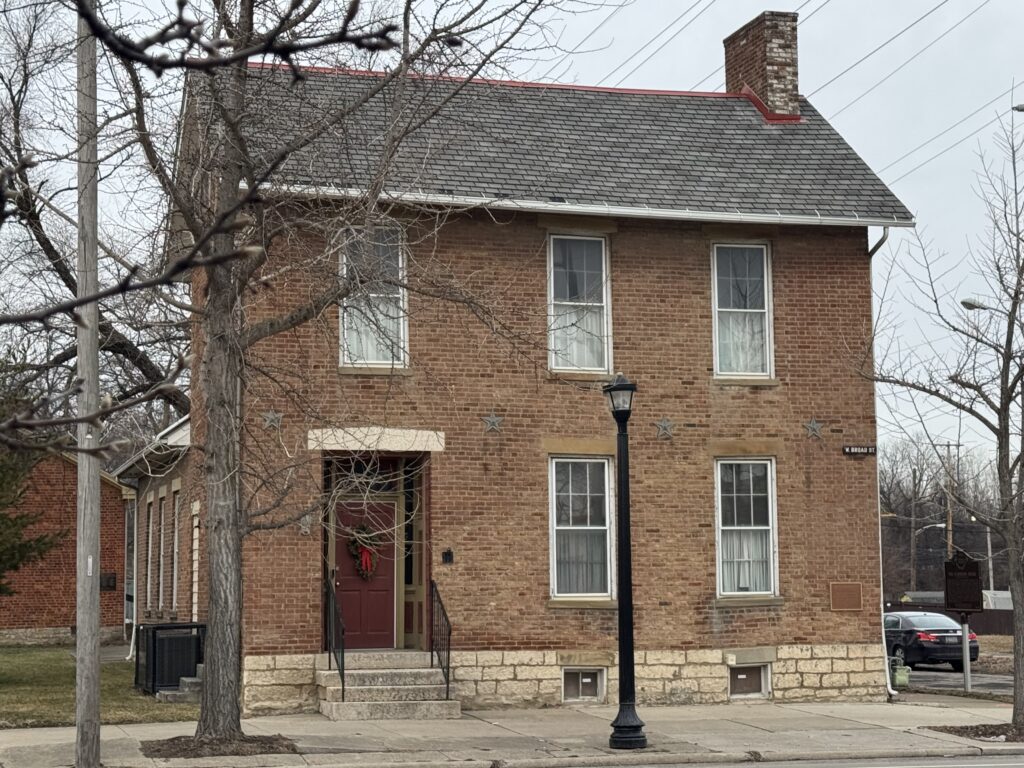
In 2021, the city of Columbus transferred ownership of the Harrison House, a symbol of the role central Ohio played in the War of 1812, to the Columbus Historical Society which is used today for small events, exhibits and meetings.
A 352 foot tall monument was erected in 1915 to honor Oliver Hazard Perry on South Bass Island commemorating his important naval victory.
If Ohio were to claim Harrison as one of its presidents, he would be the only one elected prior to the Civil War. According to author Heather Cole, “the Ohio presidencies were clustered in a five decade period between 1869 and 1923 arguably one of the most transformative periods in U. S. history.”
Harrison’s lone surviving child – John Scott – would later be a father to Benjamin (23rd US president). John is the only man to be son of and father to a United States president.
History remembers the War of 1812 as a draw. The United States still calls it a victory because the objective was achieved. Our battle for independence from the British was complete.
Sources: Ohio Presidents by Heather Cole, 2024; Confronting the Presidents by Bill O’Reilly & Martin Dugard, 2024; Columbus – the story of a city by Ed Lentz, 2003; A Brief Overview of the War of 1812, Mar 30, 2017, www.battlefields.org; A historical guide to old Columbus by Bob Hunter, 2012; Perry’s Victory & International Peace Memorial, www.putinbay.com; On this date in Columbus Ohio by Tom Betti & Doreen Uhas Sauer, 2013; President William Henry Harrison tribute, FOX19 NOW, Feb, 2025, www.youtube.com; Featured picture of William Henry Harrison courtesy www.findagrave.com.