
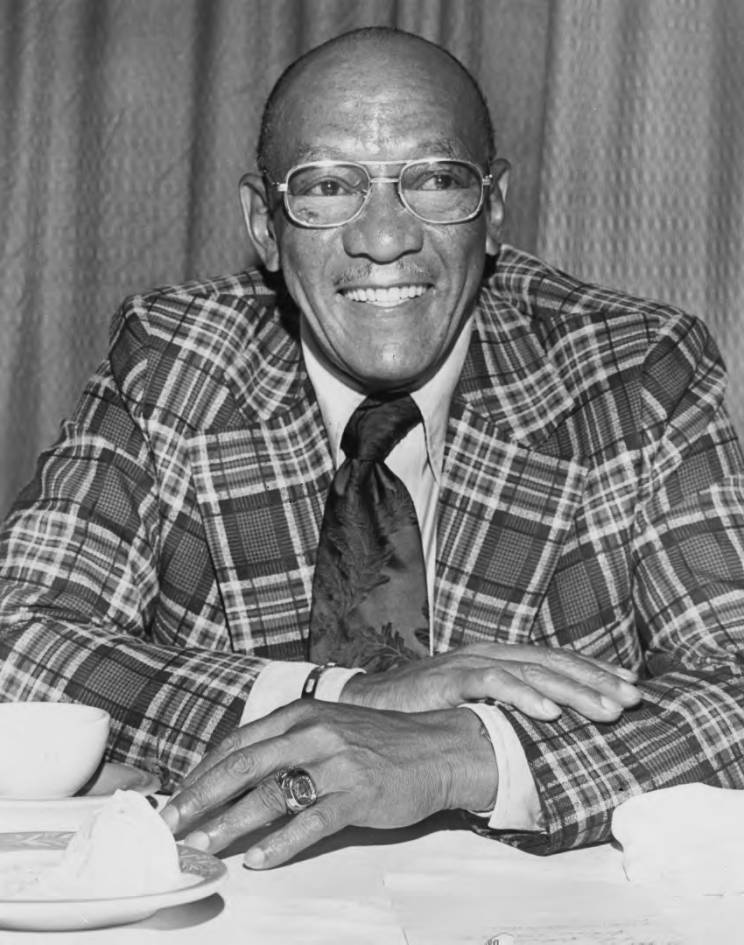
To qualify for the semifinal in the broad jump, competitors needed to leap 23 ft 5.5 inches. Jesse Owens did that in high school. This, however, was the Olympics. Its August 4, 1936, Berlin, Germany. Jesse had won his first gold medal the day before in the 100 meters by four yards with a world record tying 10.3 seconds.
Now at hand – the broad jump. Because Jesse jogged down the runway to get a feel for the track, he was given a foul. His first jump of three – in other words – was disqualified. His second jump was poor – 23 feet 3 inches. German Luz Long was his chief competitor. He came over to Jesse to offer advice. Draw a line a foot back from the foul line so you will not foul.
Was the weight of the world on Jesse Owen’s shoulders at that critical moment? Or was that even on his mind. We do know Owens was a supremely confident athlete.
With his third and final jump Owens cleared more than 25 ft and qualified to move on.
Jesse Owens was born the youngest of ten kids on September 12, 1913, in Oakville, Alabama. He was the grandson of a slave. At age 9, encouraged by his sister Lillie, Jesse’s family moved to Cleveland.
Jesse met Minnie Ruth Soloman when he was 15 and she was 13. They got married four years later in 1932. In August of that year Jesse became a father to Gloria Shirley Owens.
Jesse Owens attended Cleveland East Tech High School where he ran track and dominated. Upon graduating, he chose track & field powerhouse Ohio State which was right down the road, though he never received a scholarship.
On May 25, 1935, 21-year-old Jesse Owens tied or broke four world records within a 45 minute period at the Big Ten championships in Ann Arbor, Michigan. This despite having searing back pain from falling down a staircase a week prior while at the Alpha Phi Alpha fraternity. Jesse was a mere 5’10 160 lbs.
The Olympic broad jump came down to Long vs Owens. In the final, Long tied Jesse’s jump of 25 ft 10 inches to the delight of the German crowd. On Jesse’s turn he smashed the Olympic record by jumping 26 ft 5.5 inches. That record would stand for 24 years.
Nazi press mocked the United States team for its ‘black auxiliaries’. The New York Times called him the ‘Dark streak from Ohio State’.
On Wednesday, Aug 5, Owens qualified for the final in the 200 meters with a run of 21.3 seconds. In the final, he ran arguably his greatest race of the games – 20.7 seconds – a new world record despite being on a muddy, curved track and running into a head wind. This was Jesse Owens third gold medal of the games.
The Germans rose and cheered. Hitler left the stadium.
On Sunday, Aug 9, the day of the 4×100 relay race, temperatures were in the mid-70s. Berlin Stadium was overflowing with 120,000 in attendance. Jesse Owens was first out of the gate setting a two yard giddy-up for his team. The U.S. won with a world record 39.8 seconds. Germany got the bronze.
Jesse Owens ran & jumped his way into becoming an American & Olympic legend. He left Berlin with an historic four gold medals for the United States at a critical time in world history.
Owens was named 1936 AP male athlete of the year. He waived his final year of eligibility at Ohio State.
New York hosted a ticker tape parade for the Olympic team when they returned, however, months later President Franklin Delano Roosevelt invited only the white Olympic medalists to the White House.
The great Jesse Owens struggled to cash in on his fame in white America. He was finally offered a personnel job with Ford Motor Company in 1942 – overseeing only black workers. After four years, Owens resigned to join the upstart West Coast Baseball Association – an offshoot of the Negro baseball league – but the league folded after eight weeks.
He was reduced at one point in his life to pumping gas.
In 1966, the U.S. government named Owens a goodwill ambassador which meant Jesse would be speaking and telling his story all over the world.
He spoke in Columbus in February 1969 at the Sideliners Club annual awards banquet at the Sheraton downtown. The Sideliners Club was a group of former black athletes who played for Woody Hayes. They formed the club in 1964 to honor black athletes who were blocked from mainstream awards banquets.
Jesse Owens was awarded the Presidential Medal of Freedom by President Gerald Ford in 1976.
He died on March 31, 1980, in Tucson, AZ at the age of 66. Jesse’s wife Ruth passed away in 2001.
In 1981 USA Track & Field named their award for the year’s best track & field athlete the Jesse Owens Award. In 1983 Jesse was part of the inaugural class inducted into the US Olympic Hall of Fame. In 1984 an Emmy Award winning TV movie ‘The Jesse Owens Story’ was released with Owens portrayed by Dorian Harewood.
When the Olympic torch passed through Columbus, Ohio in June 1996 on its way to Atlanta, a couple of members of the Hilltop Historical Society made sure it passed by Jesse Owens’ house on S. Oakley Ave where he lived while attending the Ohio State University. Black students were not permitted to live on campus.
According to Mike Harden in his 2001 book ‘Road Songs’, “Owens reminded Germany that greatness is color-blind. It just took a while for his native country to get the message.”
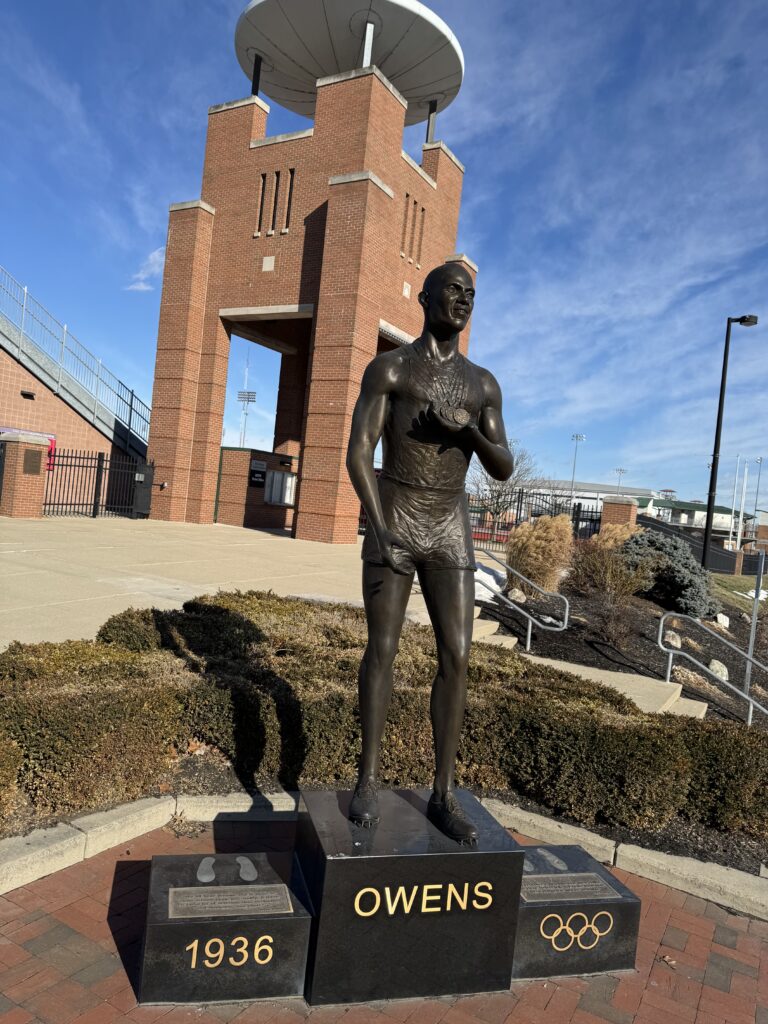
The Jesse Owens Memorial Stadium was dedicated and opened by his alma mater Ohio State University in 2001. A life size bronze statue of the ‘Buckeye Bullet’ stands out front.
Sources: Triumph by Jeremy Schapp 2007; Columbus Unforgettables edited by Robert Thomas; 101 Things you didn’t know about Columbus, Ohio by Horace Martin Woodhouse 2010; Road Songs by Mike Harden 2001; Tigerland by Wil Haygood 2019; Columbus Neighborhoods: A guide to Landmarks; Jesse Owens, ohiostatebuckeyes.com; A historical guidebook to old Columbus by Bob Hunter, 2012; ‘Cleveland native Jesse Owens achieved Olympic glory in Berlin’ by Leon Bibb, August 10, 2024, WKYC-TV3, YouTube; Featured pictures, 1978, Courtesy the Columbus C-J, Columbus Metropolitan Library and bronze statue outside Jesse Owens Memorial Stadium at the Ohio State University.