
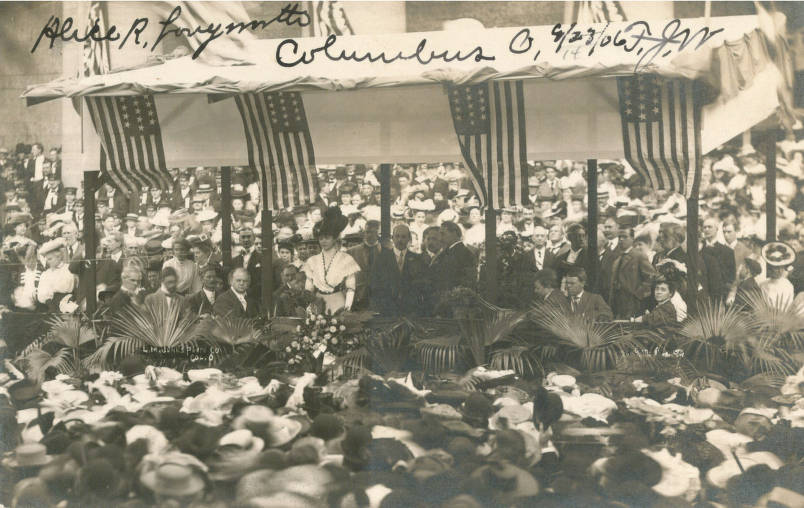
The crowd for the unveiling was overwhelming. Too many people crammed onto a lawn – though big – not nearly big enough. A real sense of an ensuing calamity was in the air. The crowd was dense. Tensions grew.
On September 14, 1906, an overflow crowd of 50,000 onlookers showed up on the west lawn of the Ohio Statehouse. This was to be the unveiling of the William McKinley Monument. McKinley was the popular former U.S. president and Ohio governor, who had been assassinated five years before.
President Teddy Roosevelt’s daughter Alice Roosevelt Longworth would do the honors and pull the rope for the unveiling.
When Teddy became president in 1901, Alice was 17 and a bit wild. She liked smoking on the roof of the White House; she did cartwheels on the White House lawn; she liked to bet on horse races, and she was known to carry a small green snake in her purse.
America was captivated. She quickly became a national celebrity and fashion icon.
Her wedding in Feb 1906 to U.S. Congressman Nicholas Longworth (36) of Cincinnati was held in the East Room of the White House and was attended by more than a thousand of Washington D.C.’s elite. It was the social event of the season and had the feel of a national holiday.
Alice famously cut her wedding cake with a sword. The media dubbed her ‘Princess Alice.’
By the time she arrived in Columbus that fall day, her celebrity status was on steroids. It’s fair to say most of the crowd was there to see the current president’s very fashionable ‘wild child’ daughter.
Only four thousand tickets were issued for the unveiling. Because of the intense crowd, however the speeches for the unveiling were re-scheduled for the following evening in Memorial Hall.
In 1891 McKinley was elected Ohio governor after serving fourteen years in the U.S. House of Representatives. With his victory, McKinley was now on the same path to the White House as his mentor Rutherford B. Hayes.
In 1895 Governor William McKinley would give the commencement address for graduates at the Ohio State University.
At the 1896 Republican National Convention in St Louis, Missouri he was nominated on the first ballot to be the party’s presidential candidate.
The campaign was one of the most divisive in American history. McKinley favored the gold standard – what he called ‘sound money’ after the recent financial crisis – while his opponent William Jennings Bryan supported the Free Silver Movement.
In November 1896, McKinley was elected our 25th president. He departed Columbus for his presidential inauguration from the Toledo & Ohio Central RR station at 379 W Broad Street. The uniquely ornate railroad station was only a year old and was built by the railroad companies.
Despite wanting to take a deep dive into the economy McKinley was forced to focus on Cuba and its growing desire to gain independence from Spain. When the battleship USS Maine was blown up in Havana Harbor, Congress declared war on Spain. The Spanish-American War was fought on the ground and waters around Cuba & Puerto Rico and on another front in the Philippine’s.
A key battle in that war was the bloody fight for San Juan Hill in which the Americans emerged victorious. The first US volunteer cavalry – known as the Rough Riders and led by Lt Colonel Theodore Roosevelt – charged up the hill despite heavy casualties to disperse the Spanish. Almost one hundred years later Roosevelt posthumously was awarded the Medal of Honor (2001).
After only a couple of months, the U.S. emerged victorious gaining possession of Guam, Puerto Rico and temporarily Cuba. While Cuba would gain its independence in 1902, the U.S. gained a military base in both Cuba and the Philippine’s and some clout in Asia and the Caribbean.
In Hawaii, insurgents had overthrown the queen and after mounting pressure President McKinley signed a joint resolution of Congress making the islands a U.S. territory.
The American economy was growing at the turn of the century but with rapid urbanization and industrialization also brought slums, violence and the growing abuse of child labor. Regulation and reforms were needed. McKinley ran for re-election and chose Theodore Roosevelt (now New York governor) as his running mate in the 1900 election and he again defeated William Jennings Bryan.
“The country was in a good place as innovations began to change lives with the emergence of the radio, the airplane and even motion pictures and skyscrapers,” according to historian and author Bill O’Reilly. “President McKinley became the first president to ride in a motorcar – the steam powered Stanley Steamer on July 13, 1901.”
Six months into his presidency however, while greeting visitors at an exposition in Buffalo, New York, McKinley was shot twice in the abdomen by a 28-yr-old Polish American anarchist. While the first shot had not done any damage, doctors determined the second bullet was lodged somewhere behind his pancreas and instead of operating, sewed him up.
Nine days later, President McKinley died of infection. His assassin was executed shortly thereafter.
His wife Ida was too distraught to attend the funeral in Buffalo on Sep 14, 1901. She spent the rest of her life overseeing the construction of a memorial in her husband’s honor in Canton, Ohio though she died of the flu in May 1907 before it was completed.
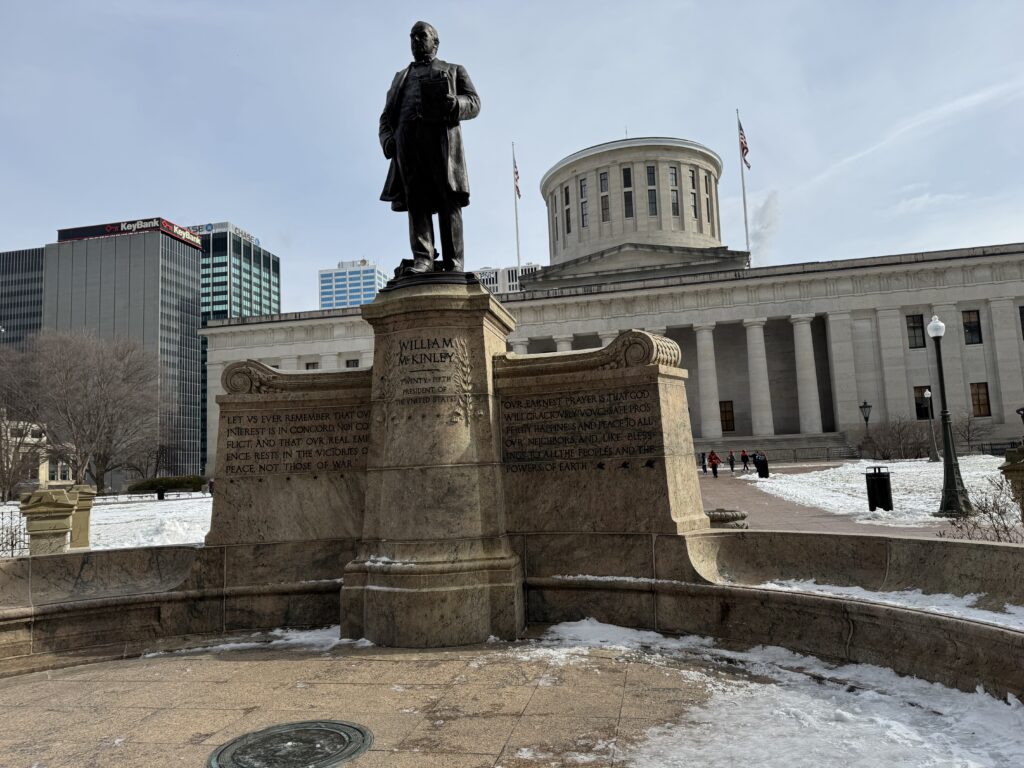
The ten foot tall bronze William McKinley Monument sits on a 15-foot high granite pedestal on the west lawn of the Ohio Statehouse. McKinley’s statue is facing across High Street toward the Neil House (that stood in his day) where he would wave to his wife Ida in a second floor window every morning on his way to work as Ohio’s governor.
He and Ida are buried at the McKinley National Memorial in Canton.
Sources: Columbus Historical Society September 2019; Ohio Presidents – A history & Guide by Heather S. Cole 2024; Confronting the presidents by Bill O’Reilly and Martin Dugard 2024; 101 things you didn’t know about Columbus, Ohio by Horace Martin Woodhouse 2010; National Veterans Memorial & Museum; On this Datein Columbus Ohio history by Tom Betti and Doreen Uhas Sauer for the Columbus Landmarks Foundation 2013; http://mckinleymuseum.org; Columbus Uncovered by John M Clark 2019; Greetings from Columbus by Robert M Reed 2008; Columbus Historical Society, T&OC RR station, Feb 2024; Ohio History Connection, Sound Money: McKinley’s 1896 presidential campaign, Feb 2025; Historic Hotels of Columbus, Ohio by Tom Betti and Doreen Uhas Sauer, 2015; Alice Roosevelt Longworth, Theodore Roosevelt Center at Dickinson State University, www.theodorerooseveltcenter.org; Something Old, Something New: Alice Roosevelt, the White House Historical Association, www.whitehousehistory.org; Featured pictures courtesy the Columbus Metropolitan Library.