
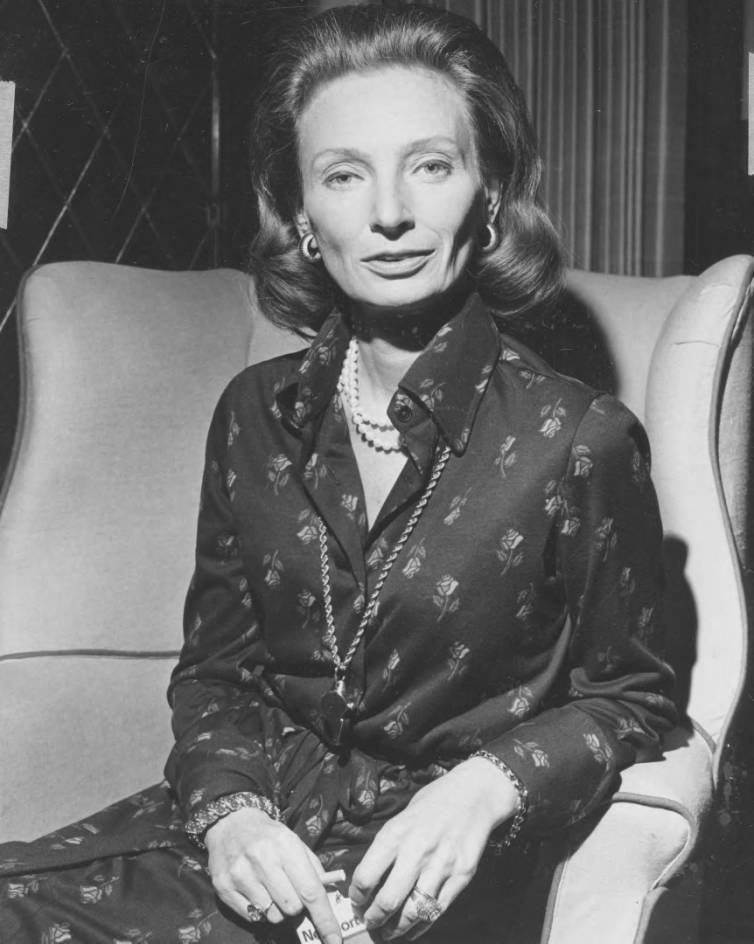
Charlotte Curtis wanted to escape the women’s pages. The newspaper business in the 1960s and 1970s was male dominated. Her ticket out – her ability to hang with the boys and her often caustic style of writing. Charlotte became a master of inserting her own personal aside on her subject.
“She skinned them without novocaine, yet they never felt a thing. Focusing a bright light on the foibles of society, yet they never blinked,”wrote her New York Times editor Arthur Sulzberger.
Charlotte grew up in Columbus Ohio, graduated from the Columbus School for Girls in 1946 and Vassar College in New York in 1950, majoring in American History.
Her parents were quite the power couple in Bexley. Her father George was a physician and researcher at Ohio State’s College of Medicine. He gained international recognition for his groundbreaking work in thoracic surgery. Lucille, her mother, was the first American female diplomat to serve overseas and later became a tireless social activist and women’s suffrage leader.
Jacqueline Bouvier (the future first lady) also attended Vassar College with Charlotte. Jacqueline was a year younger, though they did not interact. Charlotte remembered her as being sophisticated and glamorous.
Charlotte was hired by the Columbus Citizen right out of college, not as a reporter, but to write on the Society page where she worked her way up to editor.
Charlotte was demure and a petite 5’1”. She wore classic ladylike suits, with discreet jewelry, always dressing perfectly fashionable. She enjoyed fraternizing with her male co-workers and seemed to fit right in. An affair ensued with her mentor, Gene Grove. He was a tall and brilliant writer but married with children. The affair went on for years.
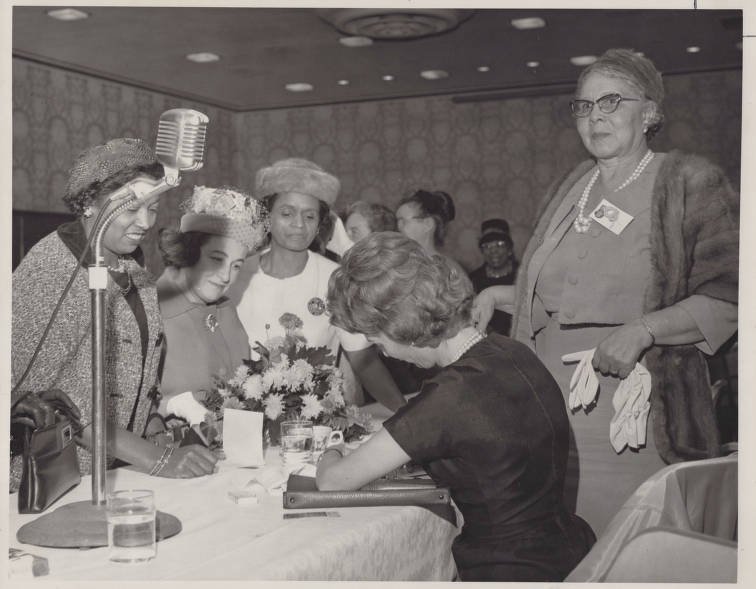
In the summer of 1960, Grove moved to New York to join the Post. Charlotte decided to move on as well. She wanted to be a reporter but instead took a job with the New York Times as a home furnishings writer in their women’s section in early 1961. Her relationship with Grove fizzled.
She bought a tiny penthouse apartment on East Tenth Street in Greenwich Village for $25,000 where she would live for the next twenty-five years.
Almost upon arriving in New York, Charlotte wrote a book about her former college classmate and now first lady. She did not interview Mrs. Kennedy for the book. First Lady, was released in the summer of 1962. It was an incredibly detailed chronology of the Kennedy’s first year in the White House, though no sales numbers exist for the book.
Meanwhile at the Times, Charlotte’s writing style made the Society pages more interesting and revealing. Her stories took on the theme of ‘poor-little-rich families,’ like the San Francisco heiress who was forced to reduce to only five servants, “all I have is a personal maid, a cook, a butler and a cleaning woman,” she said. “Well no, that’s not right either. There’s the chauffeur.”
In spring of 1965, Women’s Wear Daily, a New York fashion magazine devoted a two-page spread to Charlotte Curtis. She had become a New York phenomenon.
Charlotte began receiving invitations to the homes of the elite within the New York Times community, including to publisher Punch Sulzberger’s country home in Connecticut where she rubbed elbows with the rich & powerful. Members of the upper crust considered themselves slighted only when Charlotte did not write about them.
In 1967, she became reacquainted with a Columbus neurosurgeon, who had been mentored by her father. Dr. Bill Hunt, however, was married, had three children and did not live in New York. He was a professor of surgery & director at the Ohio State University College of Medicine. They started seeing each other. Charlotte was not only smitten, she bought her first miniskirt at the age of forty. She wrote her mom, admitting “I love it madly.”
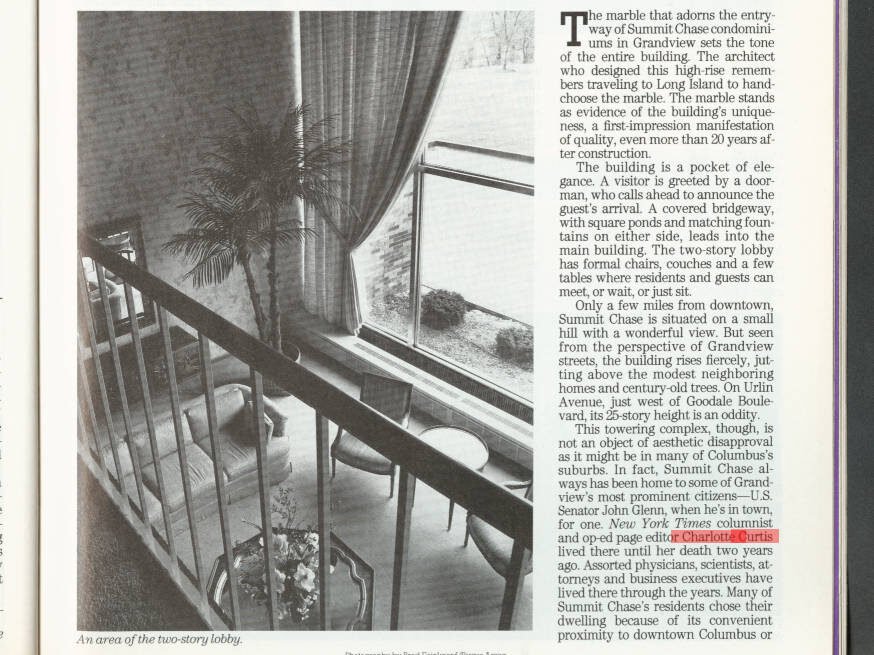
After his divorce, Dr. Hunt and Charlotte married in June 1972 in Pasadena, California. They maintained dual residences in Manhattan and Columbus, Ohio and managed to spend almost every weekend together, mostly with Charlotte flying to visit Bill. He had a penthouse apartment in the exclusive high-rise Summit Chase in Grandview.
That same summer, though few people knew the gravity of her health news at the time, Charlotte returned to Columbus to have surgery. Diagnosed with breast cancer, she had a mastectomy done at the Ohio State University Hospital. She returned to New York and went about her business.
Then, in 1974, Charlotte was named editor of the new Op-Ed page, a monumental promotion. Her energy and talent won her the position and in the midst of the women’s lib movement, she became a media darling. Suddenly, CC was the highest ranking female editor in Times history.
Two years later she released The Rich and other Atrocities, incorporating her articles into a second book. Charlotte’s work was highly sought after. CC contributed to Harper’s Bazaar, GQ, Sports Illustrated, New York Times Magazine, Ladies’ Home Journal, occasional political commentary for Rolling Stone, and for a short time she taped a daily radio commentary in New York.
In the early 1980s, Charlotte crossed paths with a 40-something rising star in international business. Limited Corporation apparel chain CEO Les Wexner admits to having spotted Charlotte on more than one occasion at LaGuardia Airport while waiting for a flight home. Both were commuting from New York to Columbus every weekend. Their bond became Columbus, the city they both adored.
Charlotte wrote two columns about Wexner. She called him Columbus’ “2000 pound gorilla,” which he thought humorous.
In 1985, Charlotte’s cancer returned. She continued working until June 1986 when she retired from the Times and began treatment in Columbus.
Charlotte Curtis died on April 16, 1987, in Columbus.
Charlotte never wanted to be a Society page writer. The social norms of her time, however, put her there. So, she wrote what was obvious to her and revealing to most everyone else.
And she not only became as famous as those she was reporting on, but one of the most influential women in the country.
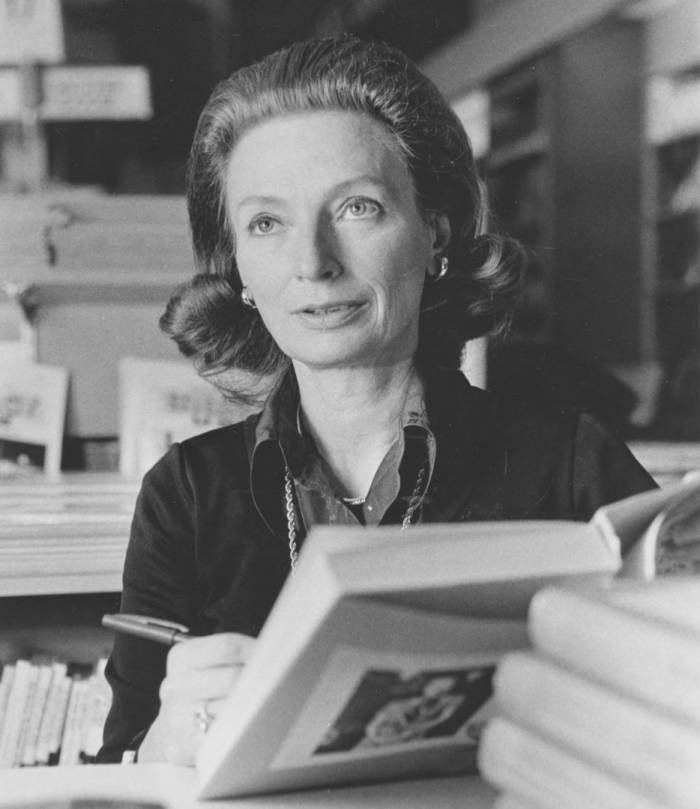
Sources: A woman of the Times by Marilyn S. Greenwald, 1999; www.archive.nytimes.com; Charlotte Curtis, journalist by Christine Hayes, Columbus Bicentennial, Jan 3, 2012, https://Columbusbicentennial.blogspot.com; Charlotte Murray Curtis, Cleveland Public Library, https://cpl.org; How great writing helped Charlotte Curtis blaze trails in journalism by Janice Harayda, May 31, 2022, www.medium.com; Curtis, Charlotte (1928-1987), www.encyclopedia.com; Studs Terkel Radio Archive interview with Charlotte Curtis, 1976, www.studsterkel.wfmt.com; Charlotte Curtis, www.grokipedia; First Lady by Charlotte Curtis, 1962; Featured picture of Charlotte Curtis was taken February 22, 1974 while working at the New York Times, courtesy the Columbus Metropolitan Library.