
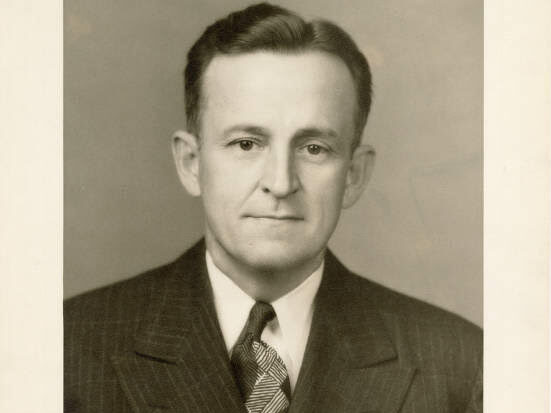
In the early 1970s, John W. Galbreath was an advisor to Nationwide Insurance. They were looking to move. He advised them to move downtown. “As you know they located on North High at what is now Nationwide Blvd,” said prominent Columbus businessman Robert Weiler. “They were thinking of looking elsewhere. So, if you could just imagine what Columbus would be like had they not been advised by John. Downtown would not be what it is today.”
In 1929, at the age of 32, John W Galbreath was broke, like everyone else. The U.S. stock market had crashed, bringing on the great Depression.
Galbreath believed real estate was universally undervalued. During the Depression, he assembled investor groups who bought defaulted real estate mortgages from banks and other lending institutions for .40 cents on the dollar. And he knew he could get low interest rates with long paybacks.
Thus, the story of one of the world’s truly great business tycoons was born.
Galbreath believed that America’s economy would rebound. It did and he and his group of investors resold their properties at a healthy profit. Not one of his mortgages went into default. Galbreath got a 5% commission on every transaction. His company made $7 million in real estate sales that year alone.
John Wilmer Galbreath was born on August 10, 1897 in Derby, Ohio, just five miles up the road from Mt. Sterling. After serving as a lieutenant in field artillery during WWI, he enrolled at Ohio University, paying his own way. Though only 5’6, he played baseball for the Bobcats.
Galbreath married Helen Mauck on September 13, 1921. Together, they had two children – a son Dan and daughter Joan. The couple moved to Columbus and, with a college buddy, John started his own real estate company. They bought a home and lived in Upper Arlington for twenty five years.
In the early 1930s, Galbreath took up polo and bought a stallion named Tommy Boy. Then he bought a couple of mares with the idea to breed polo ponies. In 1935, one of his fillies won a race at Beaulah Park earning him $400. He was hooked. That same year, he bought a one hundred acre farm in Galloway near Big Darby Creek and named it Darby Dan Farm after his son.
John W. Galbreath has been called very inspirational to be around, dynamic, approachable, and humble. He was a man of character with an undying commitment to community and was a national advocate for home ownership.
Then, in 1946, his wife Helen died.
After the war, there was an expanding housing market. Galbreath’s new challenge was to develop entire communities. With corporate and private backing, he built residential communities from Pennsylvania to Arizona.
Galbreath, a baseball fan, bought a minority interest in the last place Pittsburgh Pirates in August, 1946. He gained control of the team in July, 1950 while still living in Columbus.
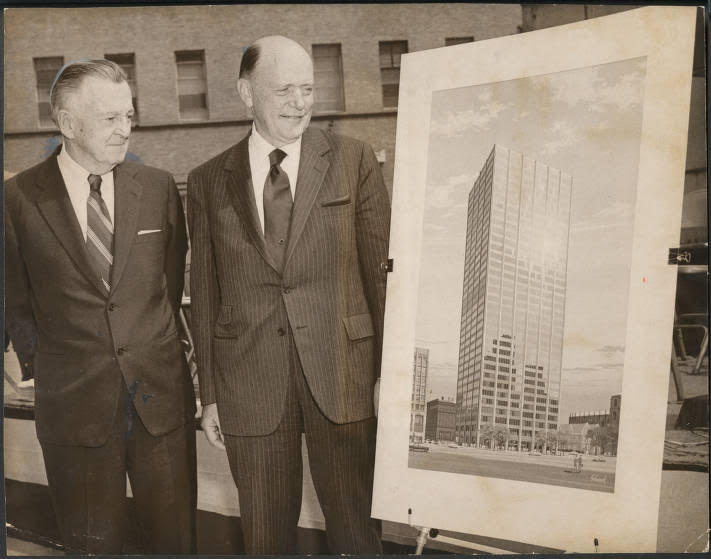
That same year, a deal with Turner Construction to build the 41-story U.S. Steel building in Pittsburgh led to dozens of collaborations. He partnered to build the 42-story Mobil building in New York, One Market Plaza in San Francisco, the Montgomery Ward Plaza in Chicago, Cleveland’s Erieview Tower, and the 40-story National Bank building in Louisville, Ky.
“He (was) in a league by himself,” said Weiler. “There’s nobody whose had the impact on our city that’s in the same category as John.”
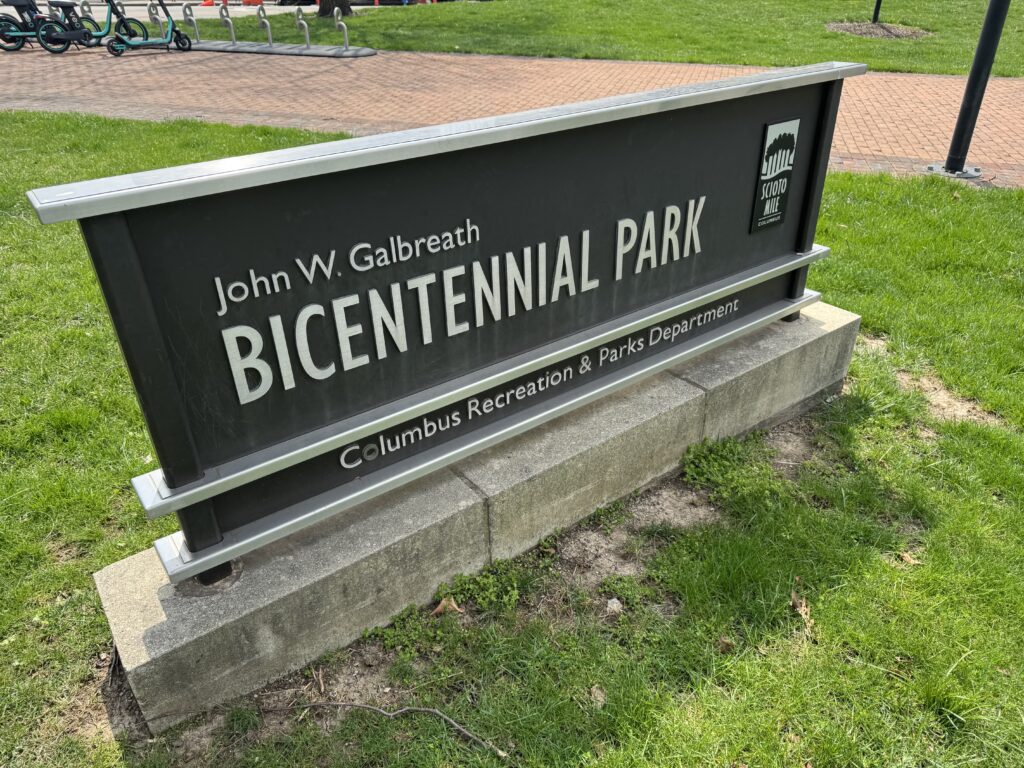
Galbreath was responsible for a major portion of the urban renewal in Columbus, Ohio in the 1970s. He literally saved the Ohio Theatre from the wrecking ball in September 1969, pledging over $1 million in the eleventh hour. And, he donated $500,000 for the fountain downtown at Bicentennial Park in 1974, including the expertise to design it.
Galbreath developed a relationship with Buckeye head coach Woody Hayes. He helped recruit Heisman Trophy winner Vic Janowicz and he employed players at his Darby Dan Farm where they painted 35 miles worth of white fence.
In addition to the Galloway farm, Galbreath bought a 650-acre horse farm in Kentucky which he also named Darby Dan Farms. It was managed by the legendary Olin Gentry.
Then he started spending big money on thoroughbred racehorses, buying former Horse of the Year – Swaps – for $2 million. He spent a stunning $1.35 million in 1960 to lease the stud services of undefeated Italian wonder horse Ribot.
He married his second wife Dorothy Bryan Firestone on Feb 18, 1955 and her horse – Summer Tan – ran third in that year’s Kentucky Derby.
In October 1960, his Pirates won the World Series for the first time in thirty five years, when Bill Mazeroski hit a dramatic walk-off home run. They would win again in 1971 behind MVP Roberto Clemente.
In 1963, the son of Swaps – Chateaugay – won the Kentucky Derby, Galbreath’s first as owner. He would do it again in 1967 with a 30-to-1 longshot Proud Clarion.
Darby Dan Farm near Columbus, meanwhile, had grown to 4500 acres of bluegrass. The farm had its own landing strip, its own zoo with over fifty different species, it had a paddle-wheel Island Queen boat, and its own nine hole golf course.
In his career, Galbreath was as good a breeder as he was a racehorse owner. He bred 91 stakes winners including 1985 Breeder’s Cup winner Proud Truth.
Racing and baseball made John Galbreath famous, but his real estate deals made him rich. Galbreath travelled in a private plane managing his three careers, sometimes landing in four cities in a single day.
John W Galbreath died on July 20, 1988 at the age of 90 at his beloved farm in Galloway, Ohio. His estimated net worth was $400 million. His company, unfortunately, encountered a severe economic downturn a few years after his passing, coming close to filing for bankruptcy. In 1998 the family business was forced to merge with Jones Lang LaSalle.
The Darby Dan Farm – ten miles west of Columbus – now sits on about 1200 acres and is operated by his grandson John Phillips. It has been repurposed to host private weddings and social celebrations.
Sources: John Galbreath, 90, a Sportsman and real estate developer, dies, July 21, 1988, www.latimes.com; John W Galbreath – General, National Football Foundation, www.footballfoundation.org; John Galbreath by Warren Corbett; Sweet 60: The 1960 Pittsburgh Pirates edited by Clifton Blue Parker and Bill Nowling, 2013, www.sabr.org; www.darbyhouse.com; John W Galbreath, City of Columbus, www.columbus.gov; John W Galbreath, president of the National Association of Realtors – 1944, National Association of Realtors, www.nar.realtor; John Galbreath, National Racing Hall of Fame, www.racingmuseum.org; John Wilmer Galbreath, Upper Arlington Historical Society, www.uahistory.org; Columbus Unforgettables edited and published by Robert D Thomas; Columbus – America’s Crossroads by Betty Garrett with Ed Lentz, 1980; The man, the horse and the deal that made history by Whitney Tower, June 1, 1959, Sports Illustrated, www.vault.si.com; 2017 ULI Columbus Visionary Award – John W Galbreath, Aug 3, 2017, youtube.com; www.columbus.uli.org; John Galbreath: International Builder and friend of Ohio University by John Halley, Sep 29, 2021, The Athens Messenger, www.athensmessenger.com; John W. Galbreath, The Historical marker Database, www.hmdb.org; Dorothy Bryan Galbreath, www.findagrave.com; Saving the Ohio Theatre by Peter Tonguette, June 11, 2019, www.columbusmonthly.com; Featured picture of John W. Galbreath taken in the 1930s, courtesy the Columbus Metropolitan Library.