
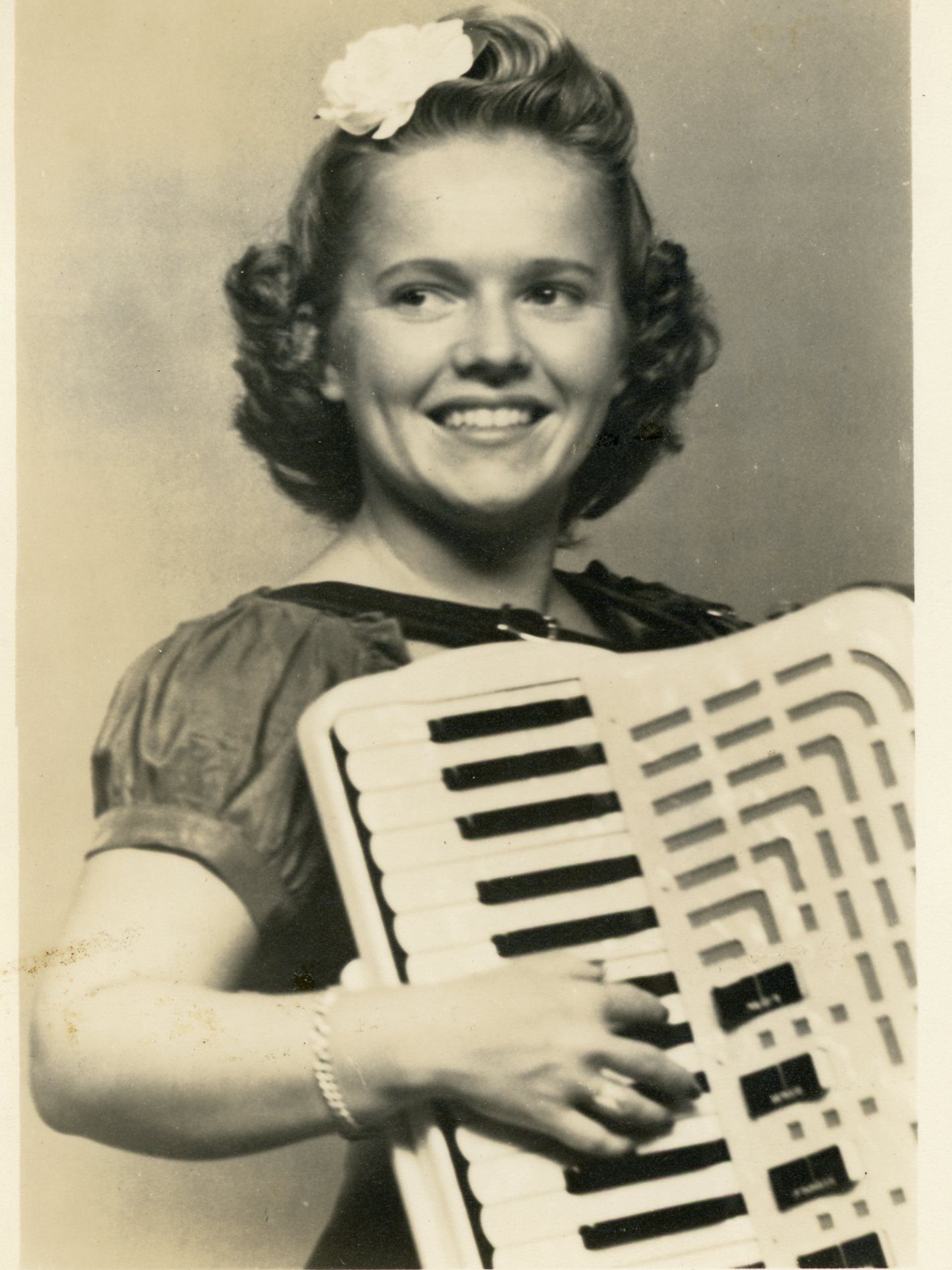
One night 23-year-old Esther Bilek and her roommate Doris noticed a lot of gunfire and flares outside their hotel. It was March 1944 in Naples, Italy during WWII. They could see the harbor was smoked out by German flares. At 1AM Naples was lit up like it was daytime. The girls hesitated to go to the bomb shelter because they didn’t want to overreact and hear it from their GI friends later.
Then a plane dipped low and dropped a bomb near the corner of their hotel throwing the iron from the streetcar tracks against the hotel. The building shook.
At that point, the girls immediately grabbed their flashlights and made their way to the bomb shelter. Everyone else was already there. Esther walked up and down the corridor talking to everyone. The Italians staying at the hotel were in the bomb shelter with the military and had fear written all over their faces.
After what seemed like hours, the bombing stopped.
Esther Bilek grew up in Rome, New York, a small town fifty miles east of Syracuse. Esther took to playing the accordion at a young age and had her own radio show in Utica, NY at the age of fifteen.
Long story short, she found herself in Naples, Italy on that day because she had signed up to be a USO girl and play her accordion for the U.S. Army troops along with other talented entertainers.
Esther was a petite 4’8” and was an absolute rock star amongst the troops. She and her fellow entertainers had a show almost every day and, for a two month stretch, they played twice a day. They played on makeshift stages in the rain; they played in the brutal cold, and even for a bomb group in an underground cave. They played at a stable with large haystacks, in hospitals and at air bases where the sounds of fighter planes departing was deafening.
Her time was in constant demand as GIs would come backstage and invite her out almost every night. She accommodated them by going to movies with a group or a double date, going to the Red Cross for ice cream or just taking a tour around town in an Army jeep.
Upon returning to the states, Esther met and married Warren Craw from upstate New York. They tied the knot on Christmas Day in the early 1950s. For the next six years she stopped working and had four children. The family moved to Columbus Ohio in the 1950s because of Warren’s work.
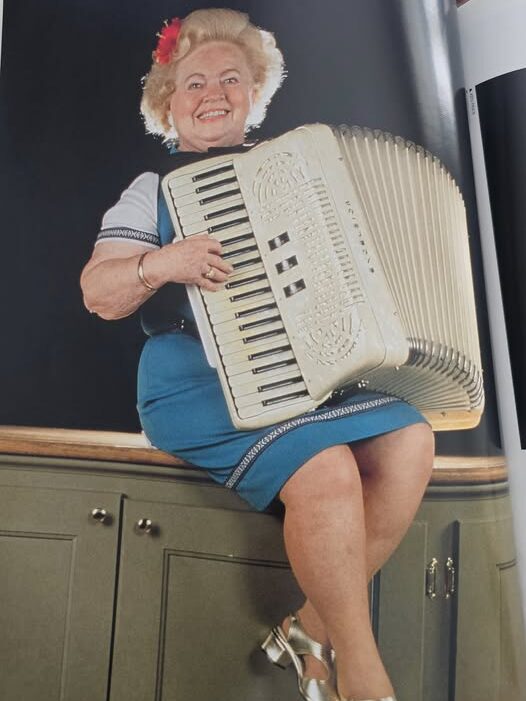
In 1969 Tom Silcott of Baltimore, Md. purchased Deibels, a bar near German Village on the south side of Columbus. He not only updated the biergarten, but he hired Esther to play accordion one weekend in the front room. She was a hit.
Esther soon became the main event several nights a week. She was energetic, a bundle of joy, fun to watch, could make the room smile and truly enjoyed entertaining others.
Her bass player was Glen Wilson. The favorite sing-a-longs were ‘Let Me Call You Sweetheart’, ‘Roll out the barrel’, ‘Pass the Lei’, and ‘Shine on Harvest Moon’. She also incorporated a ‘New York, New York’ kick line in her show and passed out kazoos possibly for ‘The Good Ship Lollipop’, a favorite request of Ohio State students. She was the best show in Columbus in the 1970s and 1980s.
Esther was the consummate performer and an icon on the south end of Columbus. Her name seemed to be synonymous with ‘the good ole days’ for a lot of people.
Esther also was not only a second mom but the ‘coolest mom ever’ to many of her kid’s friends. One of her granddaughters was named after her. Another granddaughter – Nicole – calls her “by far the best woman I have ever met.” Esther was truly remarkable.
She took her accordion everywhere she traveled just in case there was a chance to entertain. In her car, Esther had blocks on her pedals so her feet could reach them.
In addition to playing at Deibels, Esther also played at the annual Oktoberfest, Mama’s Past & Brew, the Scioto Boat Club, weddings, pep rallies, Fourth of July celebrations, many local nursing homes and occasionally at Schmidt’s Sausage Haus. At the Black Forest Inn on campus, she somehow performed ‘Script Ohio’.
She appeared on MTV’s Jon Stewart Show in 1994 and CBS Sunday Morning in 1997.
“Esther’s voice will ring in my ears for all my life,” says Columbus jazz legend Arnett Howard. “I subbed for her at Deibel’s Restaurant late in January 1986 and ended up at the place for five and a half years. Whenever she would be in the audience, it was like I was entertaining for the Queen, and she was the queen of Columbus entertainment.”
For nearly twenty one years she and bass player Glen Wilson played at Deibels Social Hall.
Esther retired in 2001 at the age of 80 and moved to Florida.
Esther Louise Craw passed away on Feb 19, 2008. Her husband Warren and son Paul had passed before her. She was survived by her three children Carol, Marshall and Lana, nine grandchildren and one great granddaughter.
Esther has been featured on the Voice of America and on the cover of ‘Women Recall the War Years’, a USO publication from WWII.
Esther’s accordion with her name in rhinestones is displayed at the Motts Military Museum in Columbus, Ohio along with her USO uniforms.
Coming in 2026: Tales of old Columbus will certainly be writing about Esther Craw’s incredible, once in a lifetime, patriotic, and often harrowing trip serving as a USO girl in Algeria and Italy in 1944 during WWII. Stay tuned.
Sources: Women Recall the War Years, Memories of WWII, presented by USO Camp Shows, edited by George L McDermott; Esther Craw USO Diary (furnished by son-in-law Mike Cannell); Esther Craw Obituary (2008) – The Columbus Dispatch, Esther Louise Craw, www.legacy.com; You know you’re from Columbus if.., group by Kendra KayLay Latham, Jan 6, 2025, Facebook; Thomas Silcott Obituary, www.dignitymemorial.com, April 15, 2021; Barcelonacolumbus.com; Lost Restaurants of Columbus Ohio by Doug Motz and Christine Hayes, 2015; ‘Little accordionist drew crowd in German Village’, Columbus Dispatch, Feb 22, 2008; Mocktail Mondays at Main with Doug Motz, Oct 6, 2025; Special thanks to son-in-law Mike Cannell, daughter Lana Waud in Seattle and granddaughter Nicole for furnishing resource material and pictures. God bless you!