

The legendary Jim Thorpe played in a football game in front of 3000 fans at Neil Park on Cleveland Ave in Columbus, Ohio on November 30, 1922. His Oorang Indians, upended the Columbus Panhandles 18-6.
The headline on page forty two of the Columbus Dispatch was simply “Panhandles lose to Thorpe’s 11”. Thorpe threw a 40 yard touchdown pass and the Indians later got a pick six. Columbus would go 0-8 in 1922, in a season in which they lost a game to the Green Bay Packers 3-0.
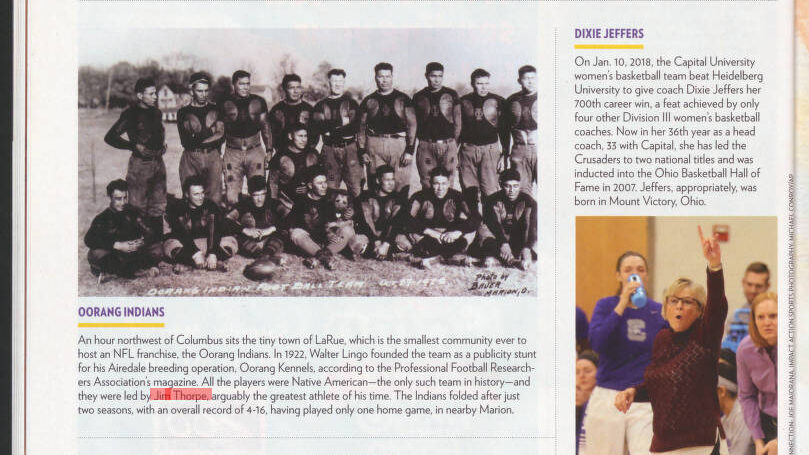
The Oorang Indians were based in LaRue, Ohio about fifty miles north of Columbus. The small village, a member of the National Football League for two years, was known for its world class dog kennels and breeding facilities. Their owner, Walter Lingo, wanted to promote his business so he paid the $100 entry fee and built a team.
The kennel’s signature dog was the Oorang Airedale, a terrier breed that was imported from England. Hunters from across the country would visit LaRue, Ohio including movie star Gary Cooper, baseball greats Ty Cobb and Tris Speaker and boxer Jack Dempsey. Even President Warren Harding had an Oorang Airdale in the White House named Laddie Boy.
Thorpe got $500 per week to be player-coach for the LaRue franchise primarily because he was easily the most famous athlete of his generation. Jim Thorpe’s athletic career seemed to evolve – for a time – on an axis around sports franchises near Columbus, Ohio.
In Sept 1915, Jim Thorpe was hired to coach the kickers and running backs for the University of Indiana’s football team. For the season he was paid $2,078.
On November 6, the Hoosiers traveled to Columbus and lost to Ohio State 10-9.
At halftime of the game at Ohio Field, Jim Thorpe, born a Sac & Fox Indian in Oklahoma, wowed the fans with his kicking ability.
Later that fall, the Canton Bulldogs GM Jack Cusack signed Jim Thorpe to a contract paying him $250 per game. The team drew 8000 fans for their first game. Thorpe would lead Canton to three ‘unofficial’ world championships in 1916, 1917 and 1919.
Thorpe was fiery but humble. He had a huge heart and never forgot about his Indian roots. He was married three times and had a total of eight children with his first two wives.
Just before Christmas in 1916, despite the Indian Citizenship Act not being passed for another eight years, James Francis Thorpe received a letter from the federal government finally proclaiming him a United States citizen.
Jim was such a good athlete that he built a split career. Baseball in the spring and summer. Football in the fall. By the age of 29, Thorpe had played four years with the New York Giants in major league baseball. In April 1917, he was traded to the Cincinnati Reds for cash. Unfortunately, Thorpe struggled hitting the curve ball and was back with New York by season’s end.
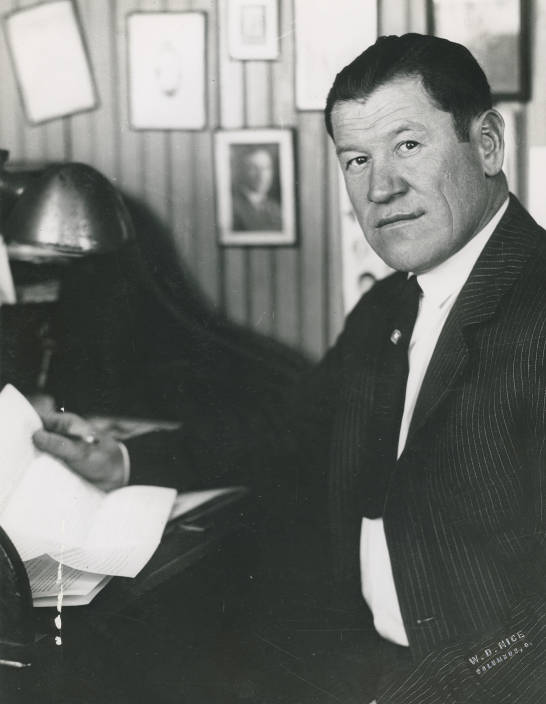
On September 17, 1920, Thorpe, playing for Akron, a triple A baseball team, went two for three at the plate against the Toronto Maple Leafs. That evening he drove to Canton for a very important football meeting, the founding of the 14-team American Professional Football Association. Jim was made president. The next year it would be renamed the National Football League.
Columbus, Ohio was a charter member.
Thorpe then found himself out of a job with the Canton Bulldogs. He of course had another offer and turned his attention to the Cleveland Indians football team in 1921 where he was given a percentage of the team’s gate receipts. The Indians finished 3-5.
That same year, the new NFL replaced Thorpe as president with Joe Carr, the manager of the Columbus Panhandles. Carr served for almost twenty years, moving the NFL headquarters to Columbus, Ohio.
The Panhandles played the first three years of the NFL – 1920 to 1922. They were one of the best known teams in the league next to the Canton Bulldogs. For Columbus, the timing was bad. Ohio State football had become all the rage with a brand new 66,000 seat stadium dedicated on October 21, 1922.
The Oorang Indians finished 3-6 in 1922 with two wins over Columbus and 1-10 their second and final year in 1923.
In 1927, the National Football League offices were moved to the eleventh floor of the 12-story Hayden building in downtown Columbus. They remained there until league president Carr died in 1939. The Hayden building was one of the first skyscrapers in Columbus. A big meeting took place there in early December 1933 to plan the first NFL championship game. In attendance was Chicago Bears president George Halas and New York Giants president Jack Mara. A week later, the Bears defeated the Giants 23-21 at Wrigley Field.
Jim Thorpe, at age 41, played his last football game on Thanksgiving Day 1928. The Chicago Cardinals signed him for the last game of the season to play against the Chicago Bears at Wrigley Field. The Cardinals offense had scored zero points the entire season. The Bears won 34-0.
Thorpe then landed in Hollywood and is credited with appearing in more than sixty films, though mainly bit roles as an American Indian.
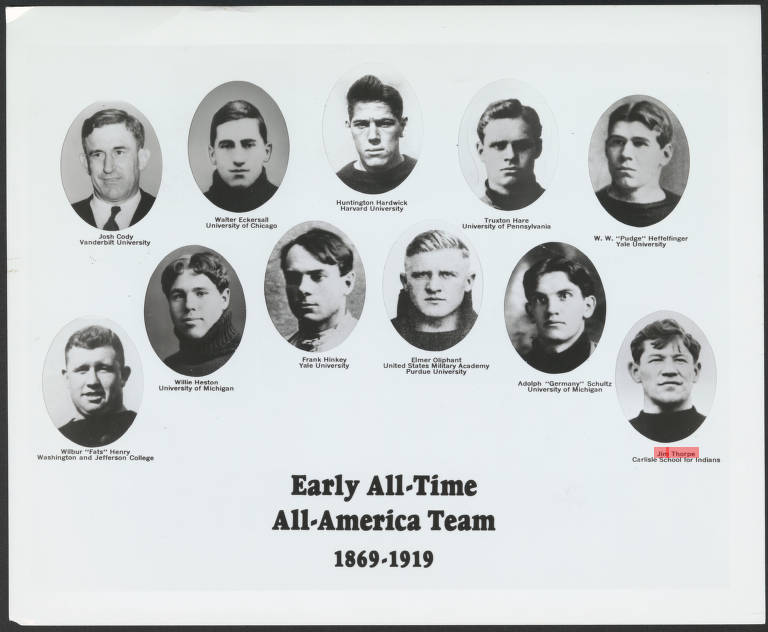
Jim Thorpe died on March 28, 1953, at the age of sixty five of congestive heart failure in Lomita, Calif. He was penniless and had to be admitted as a charity case to a hospital. His final resting place is in a marble tomb nestled in the Pocono Mountains outside of Jim Thorpe, PA.
JT was enshrined in the Pro Football Hall of Fame’s first class on Sept 7, 1963. Since 1986, college football’s best defensive back has been and still is awarded the Jim Thorpe Award. Buckeye Caleb Downs is the latest Jim Thorpe Award winner.
In 2000, an ABC Sports poll ranked Jim Thorpe as the best American athlete of the twentieth century. In 2022, the International Olympic Committee finally named JT the sole winner of two gold medals he had won in Stockholm in 1912.
The second weekend of June every summer in Larue, Ohio (Marion County), the town hosts the Oorang Bang, a two day street festival, to honor the village’s unique NFL history and the incredible legend of Jim Thorpe.
Sources: Jim Thorpe, www.profootballhof.com; Path Lit by Lightning – the life of Jim Thorpe by David Maraniss; Historical Guidebook to old Columbus by Bob Hunter, 2012; Visit Jim Thorpe, PA, Aug 21, 2025, www.poconomountains.com; The Biography of Jim Thorpe by History Hub, 2023; Jim Thorpe by Thomas Fall, 1970; Players, Teams & Stadium Ghosts by Bob Hunter, 2019; Jim Thorpe Biography, www.olympics.com; Thorpe, James Francis (1888-1953) by John Bloom, www.okhistory.com; Jim Thorpe – American Athlete, www.britannica.com; Thorpe preceded Deion, Bo by Ron Flatter, www.espn.com; Panhandles lose to Thorpe’s 11, Dec 1, 1922, The Columbus Dispatch; LaRue Oorang Bang, www.visitmarionohio.com; Jim Thorpe, Oct 14, 2020, www.biography.com; A wrong redressed: Jim Thorpe’s Olympic medals returned by Tony Pettinato, Jan 18, 2021, www.genealogybank.com; Featured picture is Jim Thorpe at the 1912 Summer Olympics in Stockholm, courtesy www.genealogybank.com.