
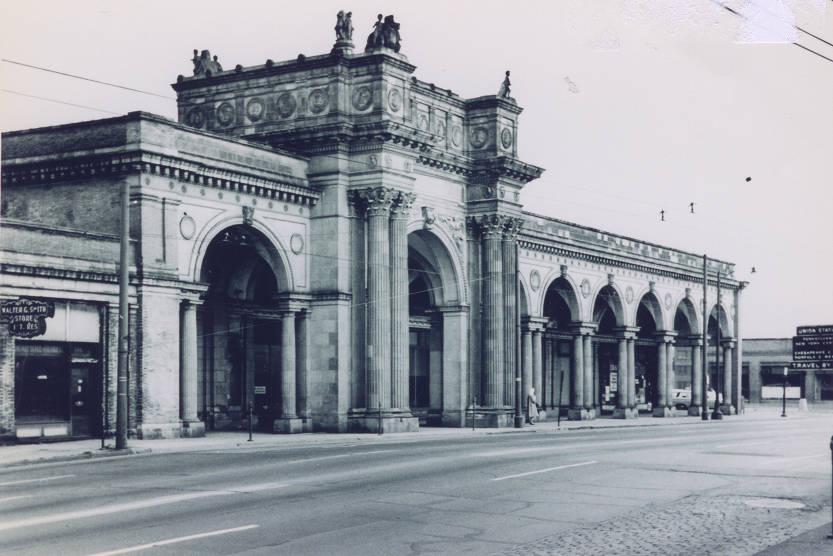
28-year-old Eddie Rickenbacker stepped off a train at Union Station on Monday morning, February 17, 1919, and America’s hero was barraged with kisses by a swarm of ladies. From the train steps to the upper platform Rickenbacker passed through a gauntlet of lovesick women.
An armistice had been signed between the Allies and Germans in November 1918 officially ending World War I. Rickenbacker, born on Columbus’ east side in 1890, recorded twenty six aerial victories.
He was one of the most successful and decorated U.S. flying aces of the war.
Waiting patiently to welcome him home that winter morning was his mother and sister. After reuniting and snapping a quick family photo, Rickenbacker was whisked away in a chauffeured automobile owned by Carl Hoster.
At that time Union Station was about twenty years old. Chicago architect Daniel H Burnham was hired in 1893 to solve the traffic problem downtown & build a new modern grand railroad station.
Ohio State University, founded in 1870, stretched the city northward. Train traffic downtown was bustling. The tracks, however, crossed High Street and trains were blocking street traffic up to seven hours a day.
Burnham built an elevated roadway – or viaduct – for horse & buggy traffic so High Street would now flow as the railroad ran underneath. A high end restaurant was built off the grand concourse with stores and shops atop the viaduct facing High Street. Nine tracks would be handling 112 passenger trains per day.
Union Station opened in 1897. It was fabulous. The arcade front was finished in 1899. Columbus had its crown jewel. “In its time there was never a place quite like Union Station,” according to Columbus historian Ed Lentz.
People of all walks of life were coming to Columbus. A member of Columbus’ board of trade at the time called Union Station “architecturally the finest, most ornate and most comfortable depot in the Middle West.”
The heartbeat of the city was Union Station. Columbus’s population in 1900 had ballooned to 100,000. Passenger service would peak at 126 trains daily in the late 1920s. The railroad industry at that time employed about 9000 people in Columbus.
In 1908 Columbus had a sizeable Italian population. On May 1 Italian tenor Enrico Caruso arrived at Union Station to a great and enthusiastic crowd of fans. He was escorted to Memorial Hall on East Broad Street where he performed before a crowd of 4000.
In November 1916 an unbeaten Northwestern football team arrived at Union Station prior to a big game with Chic Harley and Ohio State. Columbus was in hysteria over the Buckeyes success that year. Northwestern coach Fred Murphy had his twenty nine players loaded up into twelve touring cars and, rather than stay downtown, drove them to the little country town of Groveport.
The Buckeyes won their first Western Conference title the next day 23-3 at Ohio Field. And so, the behemoth of Ohio State football was born.
On May 27, 1919, former president William H Taft arrived at Union Station. An organization called the League to Enforce Peace had been established in 1915 by citizens concerned about the outbreak of war in Europe. The former president was to meet with the group at Memorial Hall on East Broad St.
Also on his agenda was a dinner in his honor at the brand new Deshler Hotel at Broad and High. In attendance would be Franklin County Suffrage organization leader Dr Anna Hall along with twenty organization members and Harvard University president Abbot Lawrence Lowell.
Voting rights had been extended to women in Canada (1917), Germany (1918), the United Kingdom (1918) and Austria and the Netherlands (1919). The United States was still a year away.
President Woodrow Wilson arrived at Union Station on September 4, 1919. The Treaty of Versailles had just been signed two months prior officially ending the state of war between Germany and the Allied powers. Wilson gave his first speech in favor of the ratification of the treaty here in Columbus, Ohio.
Two months later, Wilson would veto the Volstead Act (also known as the National Prohibition Enforcement Act). The U.S. Senate would override his veto 65 to 20.
Black Americans, escaping the ugliness of the south and seeking better economic opportunities, arrived at Union Station in droves in the 1920s and 1930s.
In 1924, the Ohio State Limited Rail connected Cincinnati through Columbus & Cleveland to New York. You could do the entire connection in sixteen hours. Service west would soon follow with connections to Chicago, St. Louis and Indianapolis.
By the end of WWII, the age of the railroad had passed. Rail service began falling off as more people traveled by car & goods hauled by truck. By 1956 Columbus was down to 42 daily passenger trains.
Union Station became mostly deserted in the 1960s and 1970s with only one daily passenger train through this period – a Chesapeake & Ohio train from Ashland, Ky to Detroit and back.
Penn Central went bankrupt in 1971. Union Station’s last passenger train was September 30, 1979.
Unbelievably, despite holding a place on the National Register of Historic Places, Union Station – one of the most revered structures in Columbus history – was demolished on October 22, 1976.
And with it went a century of Columbus’ storied past.
Late in the 20th century, a retail cap over I-670 that connected Columbus to its short north area was proposed and approved. The $7.8 million project was completed in October 2004.
The cap’s design echoes that of Union Station.
It was Columbus’ crown jewel. It’s heartbeat. The embodiment of and connection to our rich history from the railroad era.
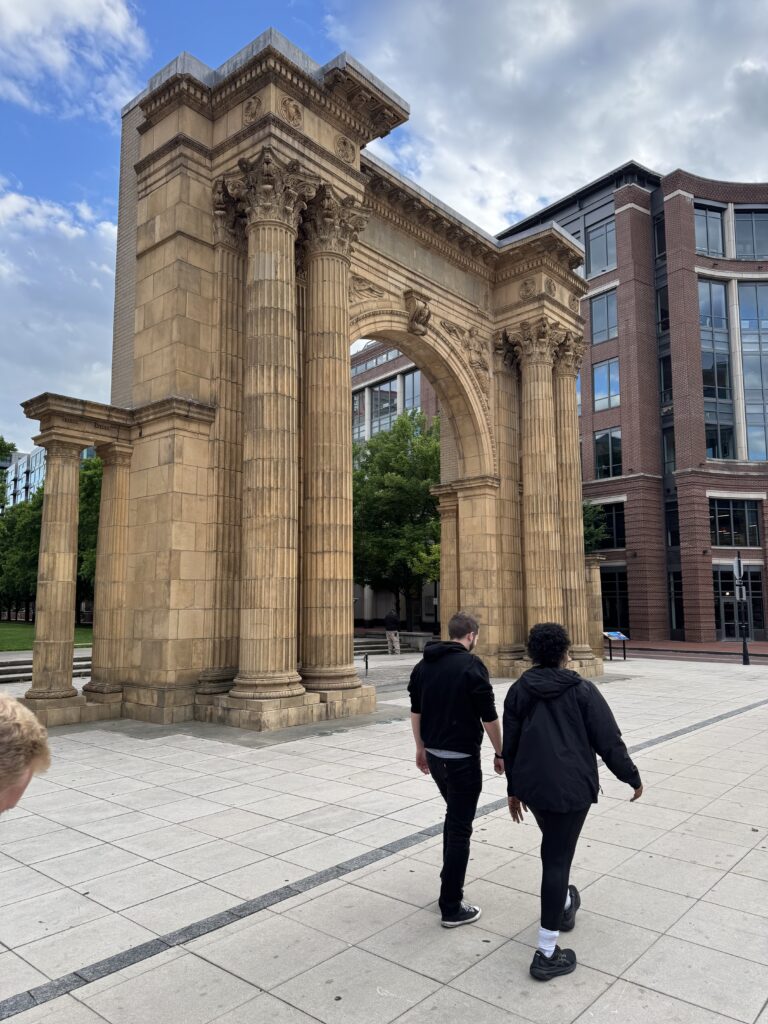
NOTE: Columbus Landmarks was established in 1977 as a direct result of the demolition of Union Station. Its mission is to preserve Columbus’ historic neighborhoods and landmarks. The Union Station arch – the lone surviving remnant from that fateful day in 1976 – was moved to McFerson Commons in 1999 where it stands today.
Sources: Forgotten Landmarks of Columbus by Tom Betti & Doreen Uhas Sauer, 2013; Columbus – the story of a city by Ed Lentz, 2003; On this Day in Columbus Ohio History by Tom Betti & Doreen Uhas Sauer, 2013; Tigerland by Wil Haygood, 2018; Columbus Dispatch, February 8, 2018; Columbus Unforgettables, edited by Robert Thomas; Historical Guidebook to old Columbus by Bob Hunter, 2012; As it Were by Ed Lentz; Secret Columbus – A Guide to Weird & Wonderful by Anietra Hamper; Columbus 1910-1970 by Richard E Barrett, 2006; fhwa.dot.gov Project Profile: The Cap at Union Station 1996-2004 (planning & approvals); Columbus Vignettes by Bill Arter, Vol I, 1966; Featured picture courtesy the Columbus Metropolitan Library.