

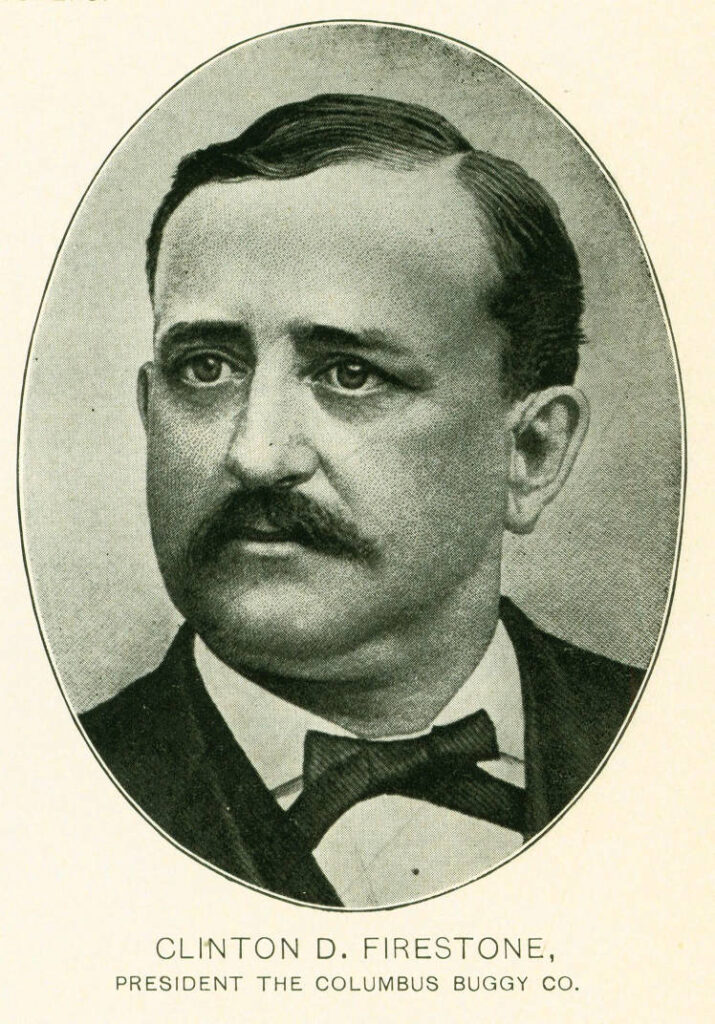
Clinton DeWeese Firestone got a letter from his nephew Harvey in 1887 asking for a job. At the time Harvey was 19 and lived on a farm in rural Columbiana County. His Uncle Clint was president and co-founder of a light vehicle manufacturing company in Columbus, Ohio.
Clinton found Harvey a job as a bookkeeper in the coal yard of his business. By 1892 Harvey was in sales and in charge of the company’s Michigan sales district.
Soon thereafter, however, young Harvey – inspired by a demonstrator sulky he had come across with rubber tires – was off to find his own fortune. After a brief stint in Chicago, he moved back to Akron and founded the Firestone Tire & Rubber Company in 1900.
In the late 19th century, his uncle’s Columbus Buggy Company was the largest horse-drawn buggy company in the world. The CBC was a pioneer in mass production and the efficient use of labor thanks to a design created by the Peters brothers. Its plan was to build buggies priced for the average family.
Oscar & George Peters were leather workers in 1865 who expanded into buggy manufacturing but soon found themselves in debt. The Peters were then introduced to Clinton Firestone who was the son-in-law of their pastor. Firestone agreed to finance the venture with $5000 and the Iron Buggy Co was born, situated at 180 N High St.
Columbus at the time had one of the best rail networks in the world created by the Civil War, which reduced transportation costs. The opening of the Hocking Valley Railroad in 1870 meant readily available natural resources like coal, wood and iron.
After the Civil War, Columbus had doubled in size and evolved from a small frontier village to a major center of transportation and trade.
The partners sold the Iron Buggy Co to HK Tuller in 1875, parlayed that sale into a new company – the Columbus Buggy Company – and began implementing mass production. Located on the southwest corner of Naghten & High Streets (near Nationwide Blvd today), production expanded rapidly. Soon Columbus Buggy Co manufactured over sixty different models of buggies.
By 1892 the CBC plant occupied five square blocks The company employed 1200 people, built one hundred buggies and 1500 carriage dashes per day, grossed $2 million per year and exported buggies around the world.
As a symbol of his success, Firestone built an elaborate Romanesque Revival five story mansion in the prestigious East Broad Street neighborhood in April 1887. East Broad was a picturesque boulevard at the time with large trees and stately mansions. The area of Columbus was called “one of the most beautiful thoroughfares to be found in an American city,” according to Harper’s New Monthly Magazine in April 1888.
Then gas powered automobiles showed up.
Columbus Buggy Co tried to transition first to an electric coupe in 1903 but could not overcome the fact that these vehicles were limited to 20 MPH and required a long battery charge time.
In 1907, the CBC brought in a former automobile manufacturing engineer to develop a new touring car. The CBC introduced the gasoline powered Firestone-Columbus model in 1909 at the Chicago Auto Show. They bragged that the car made the trip in only five days and its price was under $2000. Initially it sold well.
A specially designed Firestone-Columbus car – the Red Wing – was even entered in the first two Indianapolis 500 races in 1911 and 1912. Both were driven by a young Eddie Rickenbacker who finished 13th and 21st.
The Ford Motor Company, meanwhile, came out with the Model T in 1908. It was a game changer. Ford’s plan was to mass produce, design and market to the average American family. It’s price – $850. The Model T had a twenty year run with production discontinued in 1927 after over fifteen million units were sold. The Model T’s success led to widespread adoption of automobiles and had a profound impact on American society and culture.
Detroit’s auto makers could buy massive amounts of steel by ship at a lower cost. The Columbus Buggy Company couldn’t compete. By the time the Great Flood of 1913 hit Columbus, there was only one decision left. The company closed its doors and declared bankruptcy.
Allen Motor Company moved from Fostoria to the CBC’s old building in 1919 to manufacture automobiles. The company went bankrupt in 1923.
Clinton D Firestone died in 1914. His beautiful mansion at 580 E Broad Street was demolished in February 1962. He is buried in Greenlawn Cemetery.
Oscar Peters suffered a nervous breakdown in 1893 and was sent to the Jackson Sanatorium in New York. He committed suicide in 1894. Oscar’s brother George died in 1897. He is buried in Greenlawn Cemetery.
Harvey Firestone developed a relationship with Henry Ford to supply the Ford Motor Company, which of course contributed to his company’s success. Firestone died in February 1938. Bridgestone acquired Firestone fifty years later for $2.6 billion.
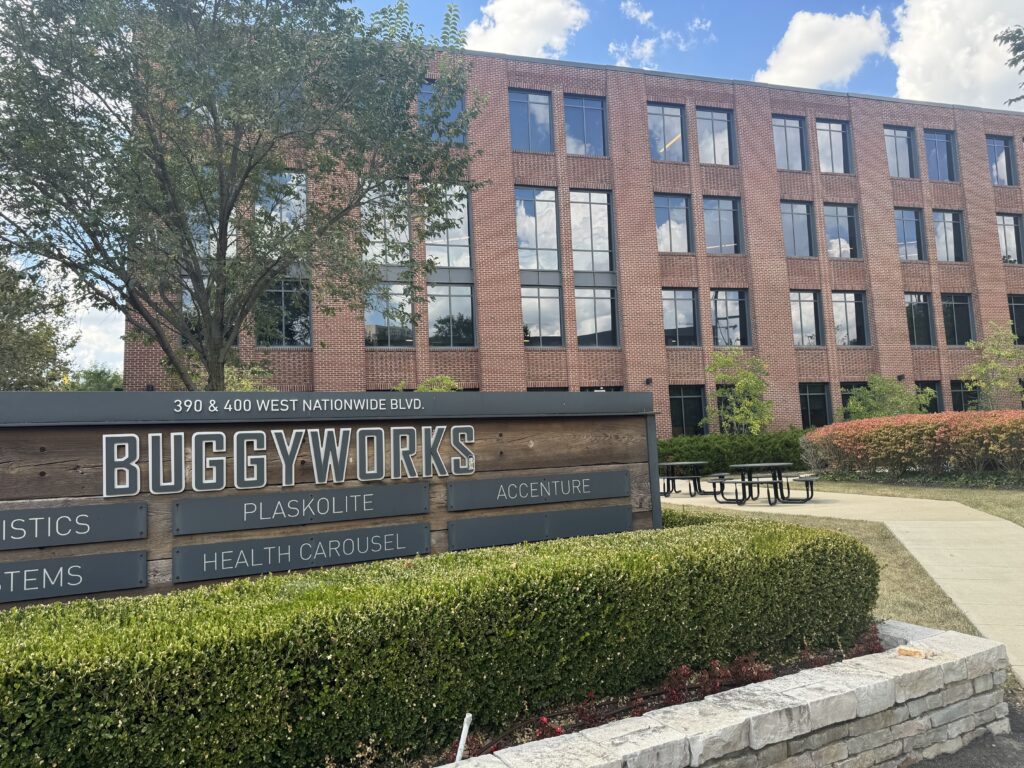
The Columbus Buggy Company factory at 400 Dublin Ave was repurposed in 2005 and is now housing lofts, condos and offices on W Nationwide Blvd. The Buggy Works development is a prime downtown location within walking distance of professional soccer, hockey, restaurants and bars.
Sources: Columbus 1860 – 1910 by Richard E Barrett; Industry, vision led to Bugg Co, This Week, As It Were by Ed Lentz, May 14, 2013; Columbus, Ohio Vintage Postcards: 1898 to 1950 by Richard Barrrett; Columbus Unforgettables Vol III, edited by Robert Thomas, 1991; Columbus: the story of a city by Ed Lentz; Secret Columbus – A guide to the Weird, Wonderful and Obscure by Anietra Hamper; A historical guide to old Columbus by Bob Hunter, 2012; 101 things you didn’t know about Columbus Ohio, By Horace Martin Woodhouse, 2010; Columbus 1910 – 1970 by Richard E Barrett; YouTube, Rubber, racing & research, Jan 9, 2024; digital-collections.columbuslibrary.org; Columbus Vignettes by Bill Arter, Vol III, 1969. The Buggyworks, https://buggyworks.online; Featured picture was taken around 1909 and is courtesy of the Columbus Metropolitan Library.