
The Soviet Union surprised the world in April 1961, sending up a manned rocket around the Earth for one complete revolution. That had never been done before. Then, later that summer, they did it again. The second time, Cosmonaut Gherman Titov circled the Earth seventeen times, three times flying over the USA 125 miles up.
41-year-old Mercury 7 astronaut John Glenn’s mission became clear. He was to circle the Earth – like the Soviets – propelled by the still unreliable and massive Atlas rocket. There was a space gap. The Soviets were winning. The world was watching.
A year earlier, NASA had brought hundreds of VIPs to Cape Canaveral for the first test of the Mercury-Atlas vehicle. It was unmanned. The Atlas rocket had 367,000 pounds of thrust. Sixty seconds after liftoff, the rocket blew up.
Fast forward to Feb 20, 1962, sixty four years ago this month. After two cancellations due to weather, Glenn was once again strapped into a capsule while on his back and nine stories up. At 8:48am, the Atlas rocket – with a weight of 260,000 pounds – blasted off.
At lift off Glenn’s pulse rose to only 110, the minimum rise for a sudden emergency. “Godspeed, John Glenn.”
Glenn was forced back into his seat with as much as six G’s of pressure but his training had him more than prepared for this. At forty miles up the rocket separated from the capsule. He could see the giant Atlas booster, the weight of an average freighter, tumble behind him and grow smaller.
At one hundred twenty five miles above the Earth, he was weightless. Glenn began heading east at 17,500 mph though he was facing west in the capsule. Glenn could see the African coast and amazingly the Canary Islands.
Then a chilling development. An indicator light on the ground panicked NASA engineers. Glenn’s heat shield – needed to re-enter the Earth’s atmosphere – may have been compromised. The decision was made not to tell Glenn.
Inside Muskingum College’s gymnasium 1200 people watched a live television feed of his mission, including his dad. The Pope – John XXIII – said later he prayed for Glenn during his mission.
Ground control’s suspicions that the heat shield may be loose were growing. It was against NASA code to engage in ‘nervous chatter’. Glenn sensed something was amiss but was not permitted to ask non procedural questions.
For re-entry, if the angle was too shallow, the capsule might skip off the top of the Earth’s atmosphere and be lost forever. If the angle was too steep it would burn up the heat shield and he would fry in the capsule.
Almost to California, Glenn pushed the control button to fire his retro rockets to slow the capsule down in preparation for re-entry near Florida. He was eleven minutes away from entering the Earth’s atmosphere.
Ground control told Glenn to keep his retropack on until he passed over Texas. The retro rockets were strapped over the heat shield and if they were left on after being fired, they may hold the heat shield in place before burning off.
Then Texas control told him to leave the retropackage on through the entire re-entry. Finally, Glenn broke code. He had to ask why. His only time of engaging in nervous chatter. Texas declined to answer.
In Tom Wolfe’s best selling book ‘The Right Stuff’, Glenn said he came to the same realization with everyone else without being told. There was a problem with the heat shield.
He entered the atmosphere. The radio went silent. Glenn was lying on his back as he descended. He could see nothing but black out his window. “The thickening atmosphere helped to break his descent. Friendship 7 had slowed from 17,500 mph to 1300 mph in slightly over three minutes.” Then he saw huge flaming chunks fly by his window.
Glenn: “This is Friendship 7. I think the pack just let go. A real fireball outside.”
The capsule was rocking. If the heat shield was disintegrating then he was about to burn up. His back felt hot. The g-forces were climbing. Seven G’s. He was still 100,000 feet up. The rocking intensified.
Finally, the parachute deployed. Glenn saw blue skies outside his window. His drop slowed to forty feet per second. It was 2:45pm in the afternoon of the same day. He was gonna hit the Atlantic Ocean within six miles of the rescue ship, the U.S. Destroyer ‘Noa’, near Bermuda, just three hundred miles from the Cape.
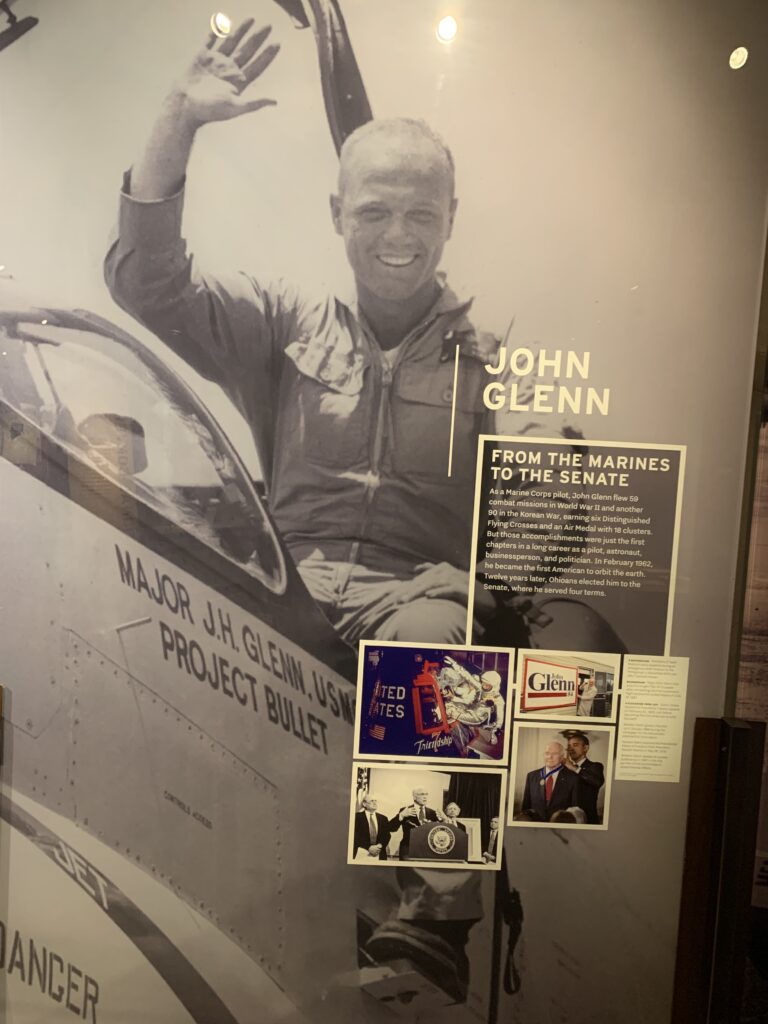
Marine Lieutenant Colonel John Herschel Glenn jr. had grown up in New Concord, Ohio and fell in love with the sky at six years old. The married father of two teenagers, travelled 81,000 miles in just under five hours. He had completed three revolutions of the Earth.
America had its hero.
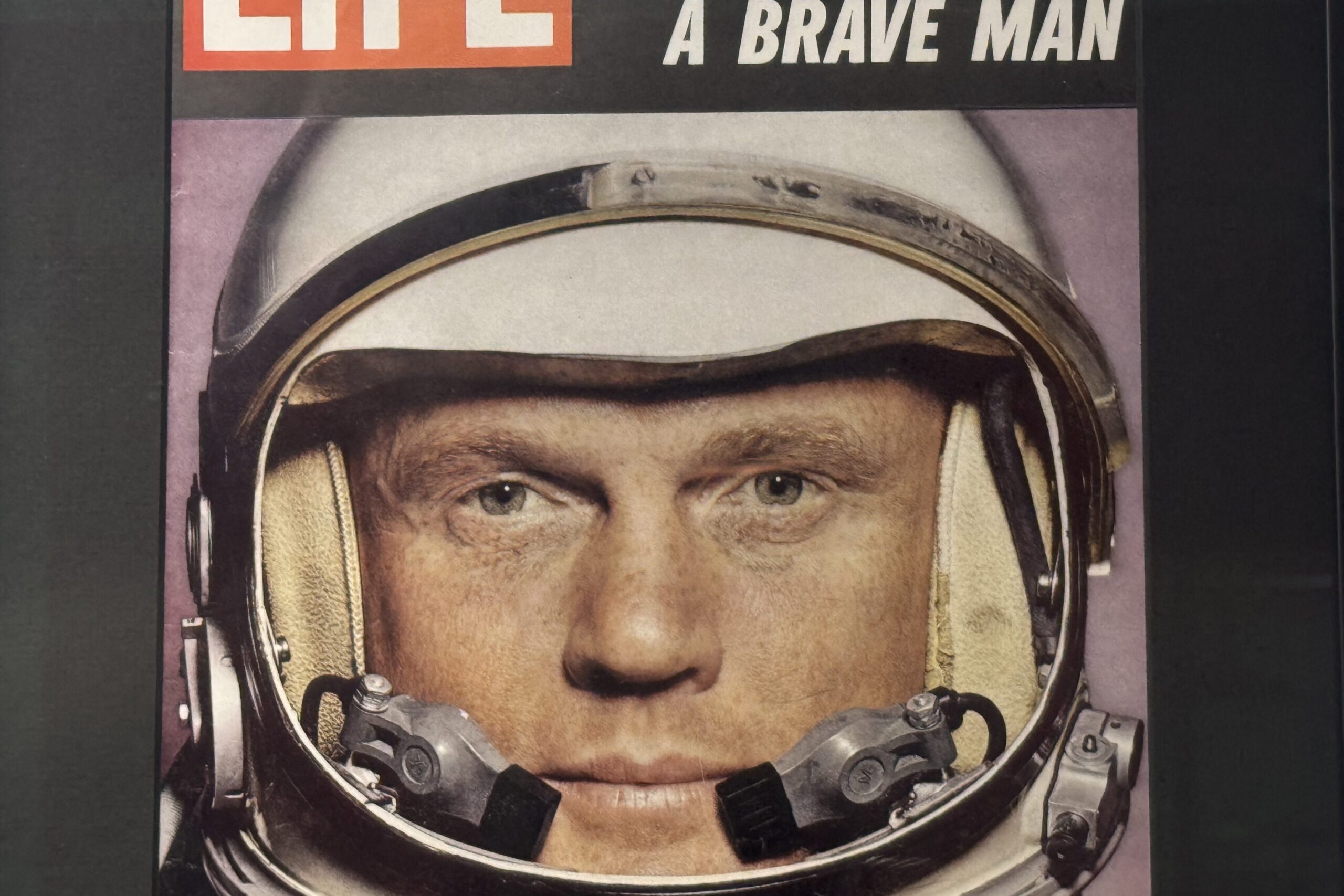
In early March, four million New Yorkers cheered Glenn and the entire Mercury 7 crew along an 18-mile ticker tape parade through lower Manhattan. Glenn appeared on the cover of Life Magazine (for the second time) that same week. A one hour documentary of his space flight was made by NASA and translated into ten languages. It was a global hit.
Three months after John Glenn’s flight, NASA announced plans to build a Manned Spacecraft Center in Houston.
The United States would land on the moon on July 20, 1969.
Twenty years later the Iron Curtain fell.
Sources: The Wingmen: the unlikely, unusual, unbreakable friendship between John Glenn and Ted Williams by Adam Lazurus, 2023; The Right Stuff by Tom Wolfe, 1979; John Glenn Story – 1962 NASA Friendship 7 project, Periscope Film, Aug 23, 2016, www.youtube.com; National Veterans Memorial & Museum, Columbus, Ohio; John H. Glenn, former NASA Astronaunt, www.nasa.gov; Death of John H. Glenn, Jr, retired Marine and U.S. Senator, www.marines.mil; John Glenn, American astronaut and United States senator, Dec 4, 2025, www.britannica.com; Seven things you may not know about John Glenn by Barbara Maranzani, Dec 8, 2016, www.history.com; John Glenn: America’s first space hero by Robert Lea, Aug 3, 2023, www.space.com; Featured picture courtesy of Columbus Monthly, March, 1983.