
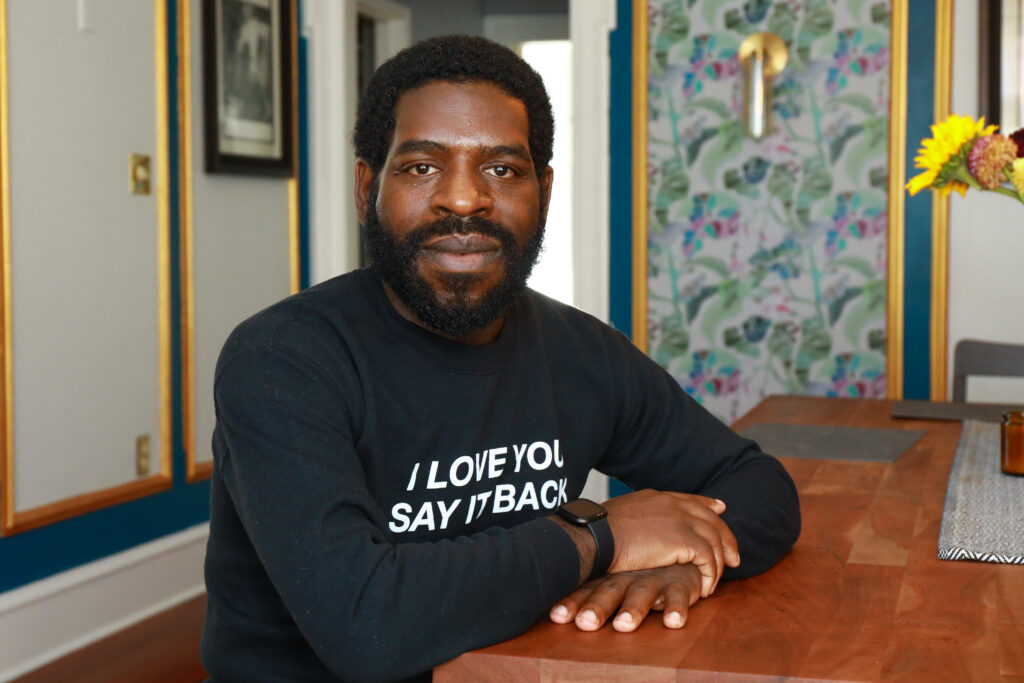
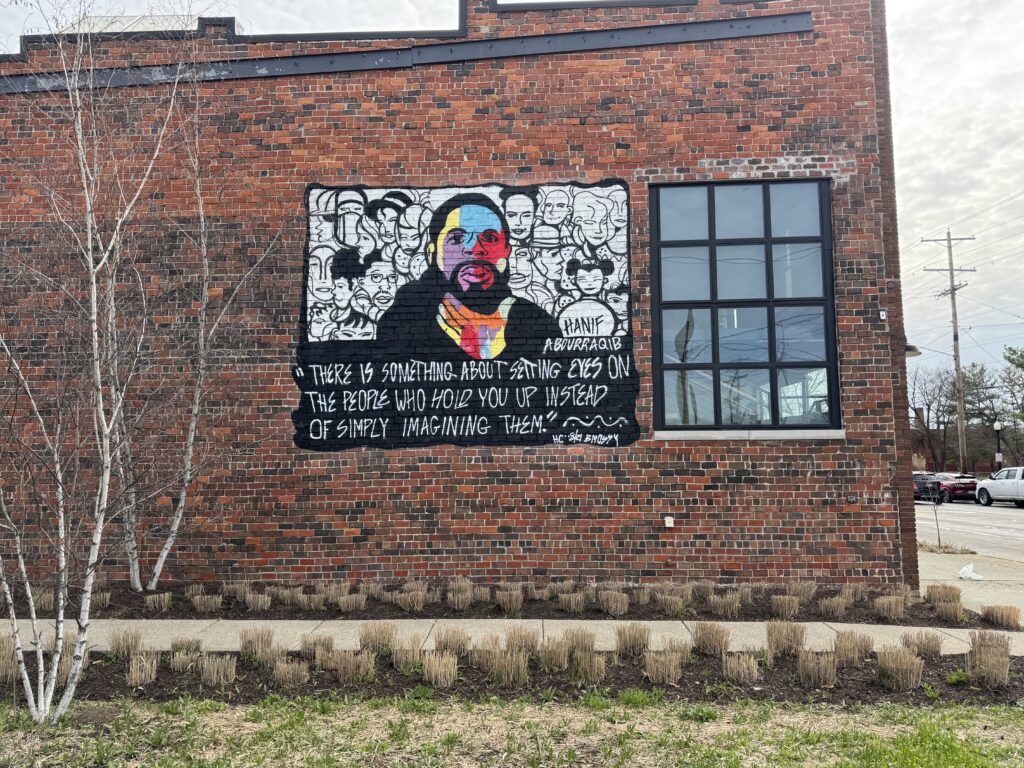
In 2021, Columbus native Hanif Abdurraqib received the prestigious MacArthur Fellow which included a $625,000 grant, he launched a music focused podcast Object of Sound, and the Columbus Metropolitan Library commissioned a mural that features his likeness on the side of a building on East Main Street.
The New York Times best-selling author readily admits, however, for a time in his life he was unhoused in Columbus, Ohio. He slept in a storage unit. He tells the story that he would walk by a large church every day. A maintenance person at the church noticed him and began to show incredible kindness by opening the church at 6am so he could sleep in a pew for three hours.
Hanif was born on August 25, 1983, in Columbus after his parents found work here. For a short time, his family lived near Greenbriar public housing on the far east side. The area was referred to by Columbus Police as ‘Uzi Alley.’
He admits to being a shy nervous kid, wracked with anxiety. “I was desperate for a way to wear silence in a way that looked and felt cool to anyone in my presence.” He called his ‘crew’ a group of nerds who were outsiders. They kept up with pop culture – music, tv sitcoms, cartoons. In high school, there is safety in belonging. The crew existed for survival.
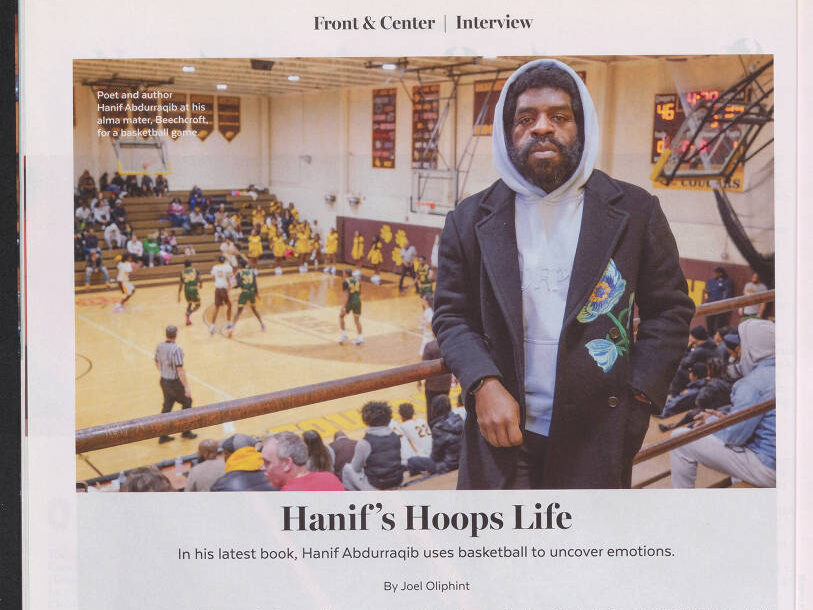
Then, in the summer before he started high school, his mother died. He lost interest in school and nearly flunked out until a teacher noticed his English test scores and placed him in AP English. That was a game changer. He graduated from Beechcroft High School in 2001.
For a time, he floundered, working a series of different jobs. He soon found himself on the street. And then in jail. Hanif got into writing because of his love of music. To him it was personal. He began writing music critiques on a free blog that no one read and progressed to local and regional papers.
He took a job at a diner downtown to pay the bills, and because they didn’t do background checks. He worked early morning shift and then went home, slept, stayed up all night writing and went back to work. He could live for a week on Kraft mac & cheese and would live for a day on a Subway footlong, splitting it in half.
In 2011, he dipped into poetry and found an artistic community in Columbus that he didn’t know existed. With no formal education, he excitedly jumped headfirst into forging his own path. He would go to open mic nights, and watch people read their work. Soon, he began hosting his own poetry open mic at a local coffee shop.
Hanif got married in 2014 and moved to New Haven, Connecticut. That, unfortunately, didn’t last and he moved back to Columbus. “I didn’t want to rebuild an emotional infrastructure anywhere else. It takes so long to do that.”
He released his first collection of poetry in July 2016, The Crown Ain’t worth much. The next year he released They can’t kill us until they kill us, an anthology of essays about music.
Hanif is described as a poet, essayist, and cultural critic who has been informed by lived experiences. They can’t kill us until they kill us was named book of the year by Buzzfeed, Esquire, NPR, Oprah Magazine, Paste, CBC, The LA Review, Pitchfork and the Chicago Tribune in 2017.
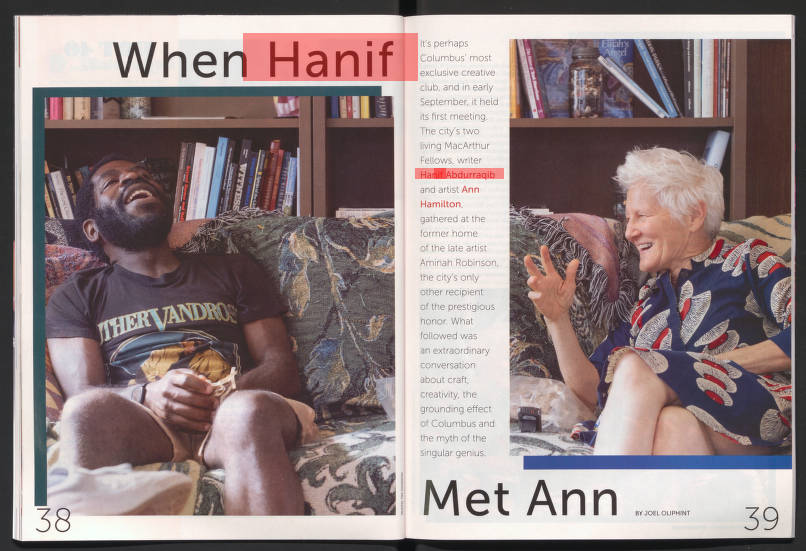
He has published nine books to date and has 112,000 followers on X. Last summer, he appeared on the Thurber House lawn for an evening of conversation and has been traveling to Stanford University regularly of late, performing his work as a Denning visiting artist.
“Hanif Abdurraqib’s voice is warm when he tells me about his love for Ohio,” says the music insiders’ website 12songsproject.com. “He talks about how grateful he is to live in Columbus, what a privilege it is. And when he’s done singing its praises, I feel like I love Ohio too, even though I’ve never been. That’s what it’s like to read his writing.”
“Lord, I am thankful today again for every reminder of how I have outlived my worst imagination,” Hanif says. “I will walk slowly through the garden of all that could have killed me but didn’t.”
In reading his work, the pearls of wisdom are profuse.
On getting a crew, “I know what it is to walk into a world that seems wild and eager to swallow you whole and want someone at your side, even if they are at your side in name only and nothing else. It would behoove you,” he says, “to have a crew.”
On living in Columbus: “My very presence (in Columbus) is keeping a history that has existed before me and a history that I want to exist after me. What’s the point of staying in a neighborhood if the neighborhood no longer feels like a place you are welcome.”
On rap music: “And so it can be said that rap became political when the people making it needed it to be fed, and it became dangerous when those people being fed realized they had the power to feed themselves forever off the power they had.”
On the Fab Five: “The Fab Five burst onto the college basketball scene in Ann Arbor in 1991. When they came back for their sophomore season, they wore black shoes, black socks, bald heads and very long & baggy shorts.” As for the white tv announcers: “there was an unspoken (and sometimes loudly spoken) glee when the Fab Five would lose. And this of course is where I came to love them more. With an intensity that led me to understand that anyone who did not love this team was my enemy.”
On burying his mother: “Sometime during the burial (at his mother’s grave) I got a dark stain of wet dirt on my pants. I remember thinking this item that my mother had worked so hard on for me to wear and feel nice. I was mourning something that my mother had poured her heart into for me. Focusing on the pants, I think, allowed me to mourn the greater loss.”
On dying: “If there is no way to make living forever appealing, let me say that I hope to live a full life loudly, and then slink off into death quietly, perhaps holding the hand of someone I have loved for so long that their emotional architecture has grown into mine.”
Hanif Abdurraqib is an absolute jewel. He clearly looks at the world and lives his life differently than most. He is a purveyor of love who knows the currency of time, and he keeps an ear tuned to what lies beneath the present.
And that’s what we love about him.
Sources: Instagram, Hanif Abdurraqib, (@nifmuhammad); There’s always this year – on basketball & ascension by Hanif Abdurraqib, 2024; Go ahead in the rain: notes to a Tribe called Quest by Hanif Abdurraqib, 2019; Hanif Abdurraqib opens up, www.12songsproject.com; Hanif Abdurraqib 2021 MacArthur Fellow video, Dec 7, 2021, www.macfound.org; How to love your hometown (w Hanif Abdurraqib and Sarah Kay) / How to be a better human, TED, host Chris Duffy, Nov 17, 2025, www.youtube.com; www.abdurraqib.com; Homecoming by Melinda Green, June 2024, 614 Magazine; https://podcasts.apple.com; Hanif Abdurraqib Poetry Community page, www.facebook.com; Featured picture of Hanif Abdurraqib is courtesy macfound.org.